BMW E36 328i: Best Drift Car in Argentina (2026)
 By Dmitrii McCarthy
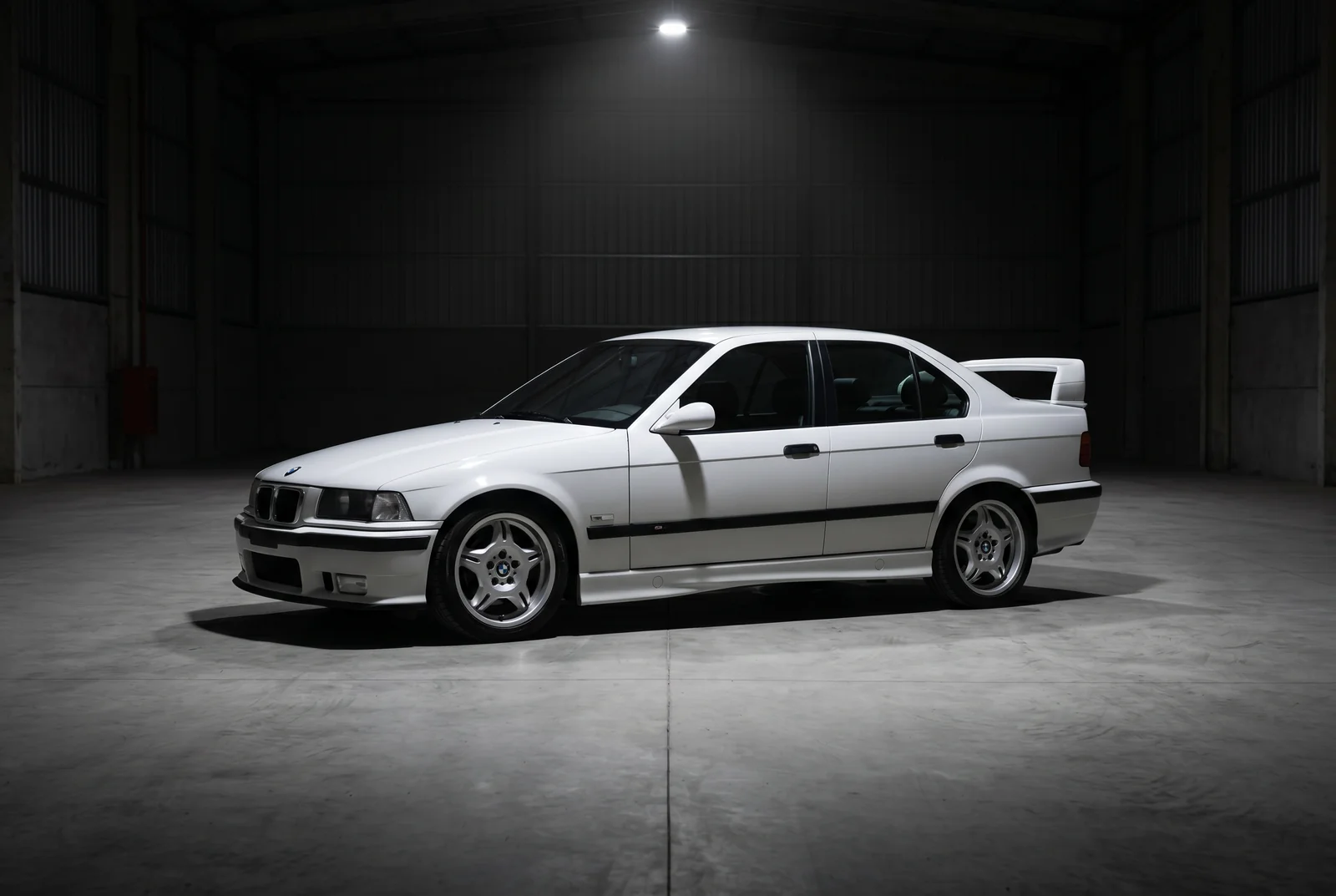
The BMW E36 328i: the legend of accessible drifting
Ask any drifter in the world what the best car to start with is, and the answer will be almost unanimous: BMW E36. It is no coincidence that it is the most popular car in drift schools from Japan to Argentina. The E36 has a combination of mechanical characteristics that make it perfect for learning, practicing and competing — all at a price that will not bankrupt you.
In this guide we explain in detail why we chose the E36 328i for our drift school, what makes each component special, how we prepare it to withstand the punishment of daily drift sessions, and why we believe it is the best car for anyone wanting to enter the world of drifting in Argentina.
The M52 2.8L engine: power you can control
The heart of the E36 328i is the M52 engine — a naturally aspirated 2.8-liter inline-6 with plenty of torque to break the rear axle loose. In drifting raw power is not the most important thing. What matters is HOW that power is delivered.
The M52 has a linear and progressive power delivery. When you press the throttle, power arrives predictably and proportionally to how much gas you give it. There is no turbo lag, no power spikes that surprise you, no zone on the tachometer where the car suddenly goes crazy. This is fundamental for learning drift because you need to control the slide with the throttle — if power comes in bursts, it is impossible to maintain a controlled drift.
Compare it with a turbocharged engine: a 2JZ with a large turbo has a 1-2 second lag before the power arrives, and when it does, it comes all at once. For an experienced drifter that is manageable, but for someone learning it is like trying to write with a pen that only writes every 3 seconds and then vomits all the ink at once.
The M52 is also absurdly reliable. There are examples with 300,000 km still running without issues. The aluminum block with iron liners is light and robust, the hydraulic tappets need no adjustment, and the timing chain lasts practically the entire life of the engine. In our school, the M52 works at full capacity every week and has never left us stranded.
50/50 weight distribution: perfect balance
One of the main reasons BMW is synonymous with driving pleasure is their obsession with weight distribution. The E36 328i has a practically 50/50 distribution between front and rear axles. This means the car is naturally balanced and neutral — it has no natural tendency to understeer or oversteer.
For drifting, this is pure gold. A balanced car allows you to initiate oversteer intentionally and controllably, instead of the car surprising you by doing it on its own. When you lift off the throttle, the car returns to its neutral state. When you step on it, the rear slides out progressively. It is like having a drift switch that you control.
Compare it with a front-heavy car: they tend to understeer, and when you finally get the rear to come out, it does so suddenly and is difficult to control. Or with a Porsche 911 with rear engine: the rear is heavy and when it lets go, it does so with lots of inertia and little warning.
Rear-wheel drive: the foundation of drift
Drifting requires rear-wheel drive (RWD). You cannot properly drift a front-wheel drive (FWD) or AWD car. The E36 comes from the factory with RWD, meaning the rear wheels are what move the car and what you can make spin controllably to initiate and maintain drift.
The rear differential is another strong point. From the factory it comes with an open differential, but a limited-slip differential (LSD) can be installed relatively easily and affordably. LSD is essential for drifting because it ensures both rear wheels spin at the same speed when you step on the gas — without LSD, only one wheel spins and it is impossible to maintain a long, controlled slide.
Our E36 has a 2-way LSD that locks under both acceleration and deceleration. This gives you total control of the slide in all phases: entry, maintenance and exit.
The ZF manual gearbox: fast and robust
The E36 328i comes with a ZF 5-speed manual gearbox that is a gem for drifting. Shifts go in with precision, the throw is short, and the gearbox withstands aggressive shifting without complaint. For drifting, most of the time you are in second and third gear. Second for slow tight corners, third for fast open curves. The gear ratios are perfectly spaced for these situations.
The chassis: rigid, light and well-proportioned
The E36 weighs around 1,350 kg, which is light by modern standards. A light car is easier to control in drift because it responds faster to your steering and throttle inputs. Inertia is lower, so direction changes are more immediate.
The dimensions are compact for a sedan: 4.43 meters long with a 2.70 meter wheelbase. The relatively long wheelbase gives stability at high speed, while short overhangs give agility in direction changes. It feels smaller than it is — ideal for Argentine circuits that tend to be technical with tight corners.
Comparison with other popular drift cars
Nissan S13/S14 Silvia
The Japanese drift classic. SR20DET turbo engine with 200-250 HP, RWD, light chassis. The problem in Argentina: they are extremely expensive (if you can find one), parts are imported and scarce, and the turbo engine has lag that complicates learning. A good S13 costs more than a fully prepared E36. The full comparison, with prices and parts availability, is in BMW E36 vs Nissan for drifting in Argentina.
Toyota AE86
The Initial D car. Light, RWD, but with a 4A-GE engine producing only 130 HP which falls short for modern drifting. Nearly impossible to find in Argentina and prices are collector-level, not track-level.
Mazda MX-5 (Miata)
Excellent car, RWD, 50/50 distribution, very light. But the engine is small (1.6-1.8L, 120-140 HP) and it is a two-seat roadster. Viable for learning drift but limited. Not enough room for the instructor to sit beside you the way our E36 allows.
BMW E36 328i — the winner
Powerful and reliable factory engine, perfect distribution, accessible parts in Argentina, reasonable price ($5,000-10,000 USD), and a globally proven drift platform. Nothing else comes close in the performance/price/availability ratio in Argentina.
How we prepare our E36 for drift
Our school car is not a stock E36. It has complete preparation costing $5,000-8,000 USD on top of the car price:
Adjustable coilover suspension: Replaces factory shocks and springs with a coilover kit allowing height and stiffness adjustment. For drift you need firmer suspension than stock for quick response, but not so hard the car bounces.
Limited-slip differential (LSD): The most important drift component after the engine. Without LSD you cannot drift properly. We installed a 2-way LSD that locks under acceleration and deceleration.
Stock, tidy cabin: We keep the factory seats, the factory seatbelt and the stock dashboard. A clean cabin lets you feel the car and focus on technique, with the instructor beside you on every lap.
Semi-slick tires: We use rear semi-slick tires that offer a balance between grip and controlled sliding.
The cost of owning your own drift E36
If after taking classes you decide drifting is for you and want your own car, here is a realistic budget:
BMW E36 328i in good condition: $5,000-10,000 USD
Coilover suspension: $800-1,500 USD
LSD: $500-1,000 USD
First set of drift tires: $200-400 USD
Labor and installation: $1,500-2,500 USD
Approximate total: depends on how far you prep the car
It is a significant investment, which is why we recommend starting with classes at our school ($300 USD for the intro) before committing financially. Many of our students started with us, took 5-8 classes, and only then bought their own car knowing exactly what they needed.
Maintenance costs
The E36 is economical to maintain compared to other drift cars. M52 engine parts are easily found in Argentina — there are specialized BMW importers, junkyards with original parts, and a huge community buying and selling parts. You will never wait months for a critical part the way you would with a Nissan Silvia or a rotary Mazda.
The main expense is rear tires. In an intense drift session you go through a set of rear tires. At $100-200 USD per pair, it is the most expensive consumable. Next are brakes (pads and discs wear faster under drift conditions) and engine oil (changed every 2-3 drift sessions because the constant high-RPM operation breaks it down faster than normal driving).
Brake fluid is another consumable that most people forget about. Under repeated hard braking and sustained heat from drifting, brake fluid absorbs moisture and loses its boiling point. We change it every 3-4 sessions to ensure consistent pedal feel and stopping power. A bottle of DOT4 racing brake fluid costs $15-25 USD — cheap insurance against brake fade.
A realistic monthly budget for an active drift E36 (2-4 sessions per month) is $400-800 USD in consumables. Not cheap, but compared to maintaining a race car in any other discipline — touring cars, rally, even karting at a competitive level — it is remarkably accessible. And unlike those disciplines, you do not need a trailer, a team of mechanics, or a garage full of spare parts.
The E36 community in Argentina
One of the biggest advantages of choosing an E36 in Argentina is the community. BMW has a massive following in the country, and the E36 generation in particular has a dedicated group of enthusiasts who buy, sell, modify and race these cars. Instagram groups, WhatsApp chats, Facebook marketplace — there is always someone selling the exact part you need, often at reasonable prices.
There are specialized BMW mechanics in Buenos Aires who know the E36 inside and out. They have seen every failure mode, know every weak point, and can diagnose problems by sound alone. Having access to this knowledge network is invaluable when you are building and maintaining a drift car on a budget.
The drift-specific E36 community is smaller but incredibly passionate. Guys who have been drifting E36s for years are always happy to share setup tips, recommend parts suppliers, and help newcomers avoid common mistakes. Go to any track day and you will see at least three or four E36s — it is the unofficial car of Argentine drifting.
Modifications beyond the basics
Once you have the basic preparation done (coilovers, LSD, drift tires), there is a world of further modifications you can explore as your skills develop:
Angle kit: Modified front suspension geometry that allows more steering lock, enabling more extreme drift angles. Not needed for beginners but essential for competition-level drifting. Cost: $300-600 USD.
Hydraulic handbrake: Replaces the stock cable handbrake with a hydraulic unit that gives instant, consistent rear wheel lockup for initiating drifts. Very popular modification. Cost: $150-300 USD installed.
Engine management: Standalone ECU or piggyback tune for more precise fuel and ignition control. Not necessary for learning but can add 20-30 HP and improve throttle response. Cost: $400-800 USD.
Cooling upgrades: Larger radiator, oil cooler, and improved ducting. Essential if you plan to do full-day drift sessions in Argentine summer heat. Cost: $300-600 USD.
The beauty of the E36 platform is that all these modifications are well-documented, widely available, and relatively affordable. There is no guesswork — thousands of drifters around the world have already figured out what works and what does not.
Why not start with a more powerful car?
We get this question a lot. "Why not learn on a 400 HP car? Would it not be more fun?" The answer is a definitive no, and here is why.
Learning drift is about developing feel, muscle memory and reflexes. The E36 gives you enough power to initiate and maintain slides, but not so much that a small mistake sends you into a wall. The margin for error is much larger, which means you can experiment, make mistakes, and learn from them safely — at moderate speeds, starting slow and building up at your own pace.
Professional drifters who compete in 1,000 HP machines all started in low-power cars. Keiichi Tsuchiya, the Drift King himself, perfected his technique in an AE86 with 130 HP. The skills you develop in the E36 transfer directly to more powerful cars — the physics are the same, just amplified.
Starting in a powerful car is like learning to swim in the open ocean instead of a pool. You might survive, but you will not learn proper technique, and you will develop bad habits born from fear rather than understanding. The E36 is your pool: predictable, forgiving and perfectly sized for building real skills.
Conclusion: why the E36 is unbeatable
The BMW E36 328i is not the most powerful, modern or spectacular drift car. But it is the smartest. It is reliable, predictable, accessible, easy to maintain, and teaches you the fundamentals of drifting in a way few cars can. It is the car that will form you as a driver, not the one that will try to kill you in the process.
Every component — from the linear M52 engine to the balanced 50/50 chassis, from the robust ZF gearbox to the simple rear-drive layout — works together to create a machine that rewards skill over brute force. That is exactly what you want when you are learning.
Learn what it is like to learn drifting in Buenos Aires with this car. Also read about how to drift a rear-wheel drive BMW. Prefer to see it in action as a passenger? The same E36 is used in the Drift Taxi and at TROMPO track days.
If you want to experience the E36 on track without buying one, book a class at driftschool.com.ar. 30 minutes, $300 USD, and you will understand why this car is a legend.
Frequently Asked Questions
Can I bring my own car?
Contact us via WhatsApp to evaluate if your car is suitable for drift sessions. We generally recommend using ours for learning.
Is insurance included?
We do not work with track insurance: the mechanism is a contract. Normal wear is included and, if there is accident damage, the student covers it as agreed. We explain everything in the pre-session briefing, no surprises.
What if I damage the car?
Normal wear (tires, brakes, fuel) is included. There is no track insurance: accident damage is covered by the student per the contract, with clear terms agreed up front — that is why the instructor is always beside you to minimize risk.