How to Drift a Rear-Wheel Drive BMW: Techniques and Tips
 By Dmitrii McCarthy
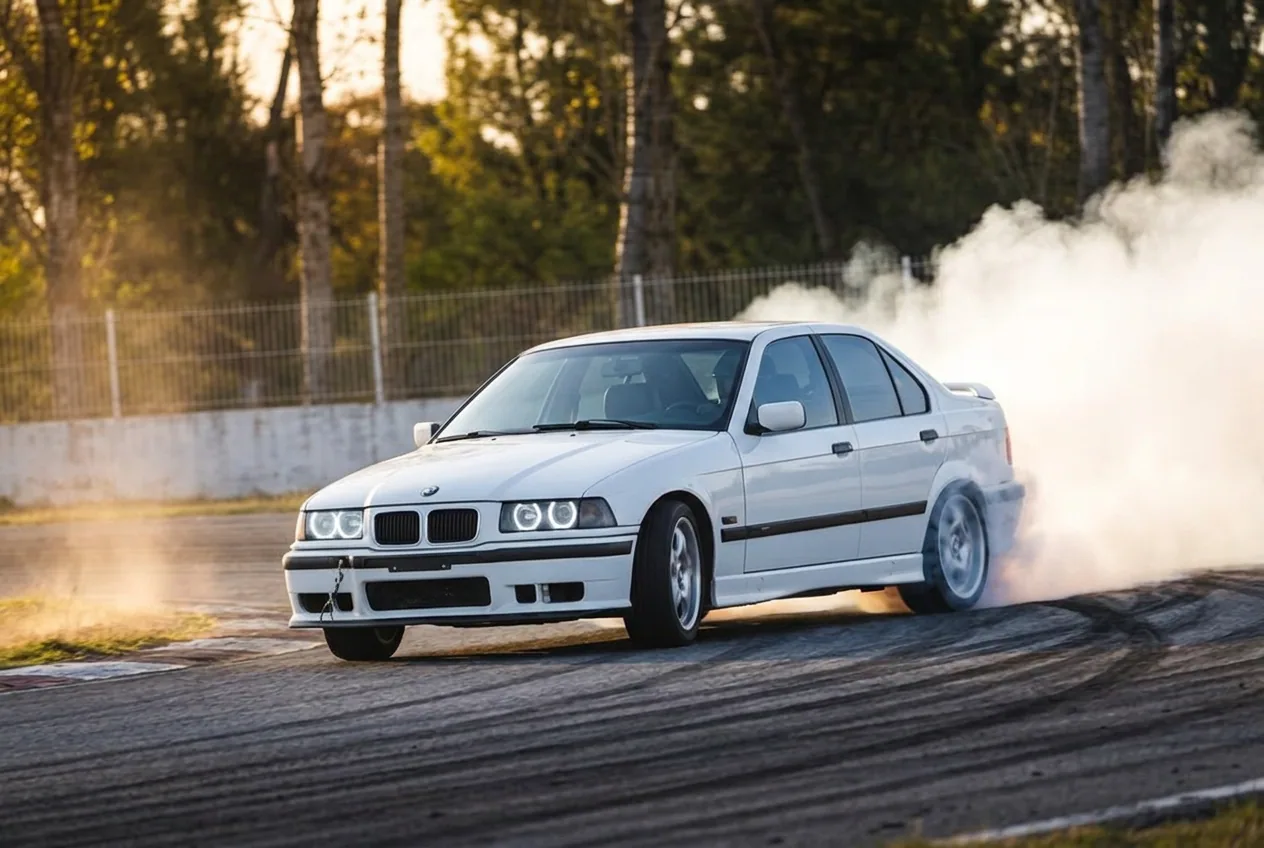
Rear-wheel drive is the foundation of drift — and the BMW is the ideal car to learn it
You cannot drift seriously without rear-wheel drive. Full stop. Front-wheel drive cars can do handbrake tricks, but they cannot sustain a controlled power-on oversteer. All-wheel drive cars can slide, but the physics are completely different. Real drifting — the kind you see in competitions, the kind that produces smoke, angle and control — requires the rear wheels to be the only ones driving the car.
And among rear-wheel drive platforms, the BMW E36 is the most popular choice for learning. Not by chance or fashion — for concrete technical reasons that make your progression faster and safer.
The physics of oversteer in a rear-wheel drive car
To drift, you need to understand one fundamental thing: oversteer occurs when the rear tyres lose traction before the fronts. In a rear-wheel drive car, you provoke this deliberately with the throttle — by applying more power than the rear tyres can absorb, the wheels spin and the rear end steps out sideways.
The beauty of rear-wheel drive is that oversteer control is directly linked to the throttle pedal. More gas means more angle. Less gas means the car straightens up. This gives you a fine, proportional control that does not exist in other drivetrains. The throttle becomes your primary steering tool — not the wheel.
The steering wheel in drift serves as counter-steer: you turn in the opposite direction to the slide to keep the car pointing where you want to go while the rear end travels sideways. The combination of throttle (which controls angle) and counter-steer (which controls direction) is the essence of drifting.
Initiation techniques: how to start the slide
Power over: throttle-induced oversteer
The most basic technique and the first you learn. You enter a corner at moderate speed and at the apex you apply more throttle than the rear tyres can handle. The wheels spin, the rear end breaks loose and you start sliding. It is the most predictable and progressive technique — ideal for beginners because the car's reaction is proportional to the amount of gas you give it.
The trick is in the timing: too early and the car understeers (pushes wide). Too late and you have missed the optimal moment. The precise point is as you pass the apex, when you have already started turning the wheel and the car's weight has shifted to the outer wheels.
Clutch kick
The clutch kick generates instant oversteer by quickly pressing and releasing the clutch while accelerating. It sends a spike of RPM to the rear wheels that overcomes their traction limit in one go. It is more aggressive than power over and allows you to initiate drifts at speeds where the throttle alone would not be enough.
The execution: you are accelerating through a corner, you stab the clutch quickly (a tap, not a hold), release it immediately while maintaining throttle. The rear wheels receive a jolt of power that makes them spin. It takes practice to nail the timing — a poorly executed clutch kick can be harsh and prematurely wears the clutch.
Handbrake
The handbrake locks the rear wheels momentarily, causing them to lose traction and the car to rotate. It is the technique everyone knows from movies, but in professional competition it is used as a supplement, not a primary technique.
In learning, the handbrake is useful in two situations: initiating a slide at low speed (where the throttle alone is not enough) and correcting a drift that is closing up (a quick dab of handbrake to reopen the angle). It is not the most elegant technique, but it is a valuable tool in your arsenal.
Feint (Scandinavian flick)
The feint is a weight-transfer technique: before the corner, you turn briefly in the opposite direction and then quickly correct towards the turn. This pendulum motion unsettles the rear end and provokes oversteer without relying on throttle or handbrake.
It is an intermediate technique requiring good timing and confidence in the car. It is used heavily in rally and in drift when you want to initiate a slide at speeds where other techniques are less effective.
Counter-steer: the key to staying in control
Counter-steer is the most important skill in drift and the one that takes the longest to master. When the rear end breaks out to the right, you turn the wheel to the right to keep the car on the desired line. It sounds contradictory, but it is what works.
The most common beginner mistake is over-correcting. If you turn the wheel more than necessary, when the car responds it will snap the other way — called a pendulum — and can end in a spin. Counter-steer needs to be proportional to the slide angle: more angle needs more lock, less angle needs less.
With an instructor beside you calling adjustments in real time, you learn this in a fraction of the time it would take alone. It is one of the biggest advantages of taking lessons at a drift school rather than trying to learn on your own.
Weight transfer: the invisible technique
Everything you do in drift involves weight transfer, even if you do not notice it. When you brake, weight moves forward and the rear tyres lighten (easier to break loose). When you accelerate, weight shifts rearward and the rear tyres load up (harder to spin, but more power available when they do).
Advanced drivers use weight transfer as an active tool: a dab of brake before the corner to lighten the rear, throttle at the apex to sustain the drift, and a weight shift when transitioning between turns. This is what separates the beginner from the intermediate driver.
Why the BMW E36 is ideal for learning to drift
50/50 weight distribution
The E36 has nearly perfect weight distribution between front and rear axles. This makes the car balanced and predictable — when you provoke oversteer, the reaction is symmetrical and easy to read.
Progressive engine
The 2.8-litre inline six (M52) delivers power smoothly and linearly. There is no sudden power spike to surprise you — power rises proportionally with RPM. This gives you the fine throttle control that is fundamental when learning.
Communicative chassis
The E36 talks to you through the steering wheel and seat. You feel when the tyres are near the limit, when the rear starts to break loose, when the car is stable or unstable. This tactile feedback is invaluable for developing the feel you need as a drift driver.
Standard modifications
The E36 has a huge ecosystem of drift parts and preparations. Welded differential, angle kits, coilover suspension, strut braces — everything is available, tested and documented. It is not an experimental platform: it is the most validated learning platform in the drift world.
What modifications a drift car needs
For serious drifting, a car needs at minimum: a locked differential (without it only one wheel spins and the drift is unstable), suspension that is dialled in (set up for the ride height and stiffness the track demands) and tyres meant for the job. The engine can be stock as long as it has enough torque to break the rear axle loose — the prepared BMW E36 328i has plenty. The cabin can stay stock and tidy: the factory seats and seatbelt are enough to start learning. Real safety does not come from the car's hardware but from the environment: a private, closed track, a professional instructor beside you on every lap, a helmet and a fire extinguisher as required by regulation.
Frequently asked questions
Can you drift a front-wheel drive car?
Technically you can do a lift-off oversteer or use the handbrake to rotate the car momentarily, but it is not real drifting. You cannot sustain power-on oversteer because the wheels that drive are the same ones that steer. For genuine drift, you need rear-wheel drive.
What tyres are used for drifting?
For practice, cheap hard road tyres (195 or 205 width) are used on the rear because they wear out quickly. The front gets tyres with good grip to maintain directional control. For competition, semi-slick tyres that produce more smoke are used.
Is it better to drift on dry or wet surfaces?
Both have value. On dry surfaces you need more power and speed to break traction, but control is more predictable. On wet surfaces the car slides easily at low speeds, which is excellent for practising technique without extreme velocity. Many advanced drivers deliberately seek wet track conditions for training.
Can I drift with an automatic gearbox?
It is possible but very limited. An automatic does not let you do a clutch kick and RPM control is less precise. Automatic gearboxes also suffer greatly under drift conditions and break easily. Nearly all serious drift cars use a manual gearbox for a reason: total control is fundamental.
Learn everything about the BMW E36 as the perfect drift car and how to learn drifting in Buenos Aires. If you are choosing your first car, compare BMW E36 vs Nissan for drifting; and to see where each technique fits, check the types of drift: tandem vs solo.