Drifting vs Performance Driving: Differences, Similarities and Which to Choose
 By Dmitrii McCarthy
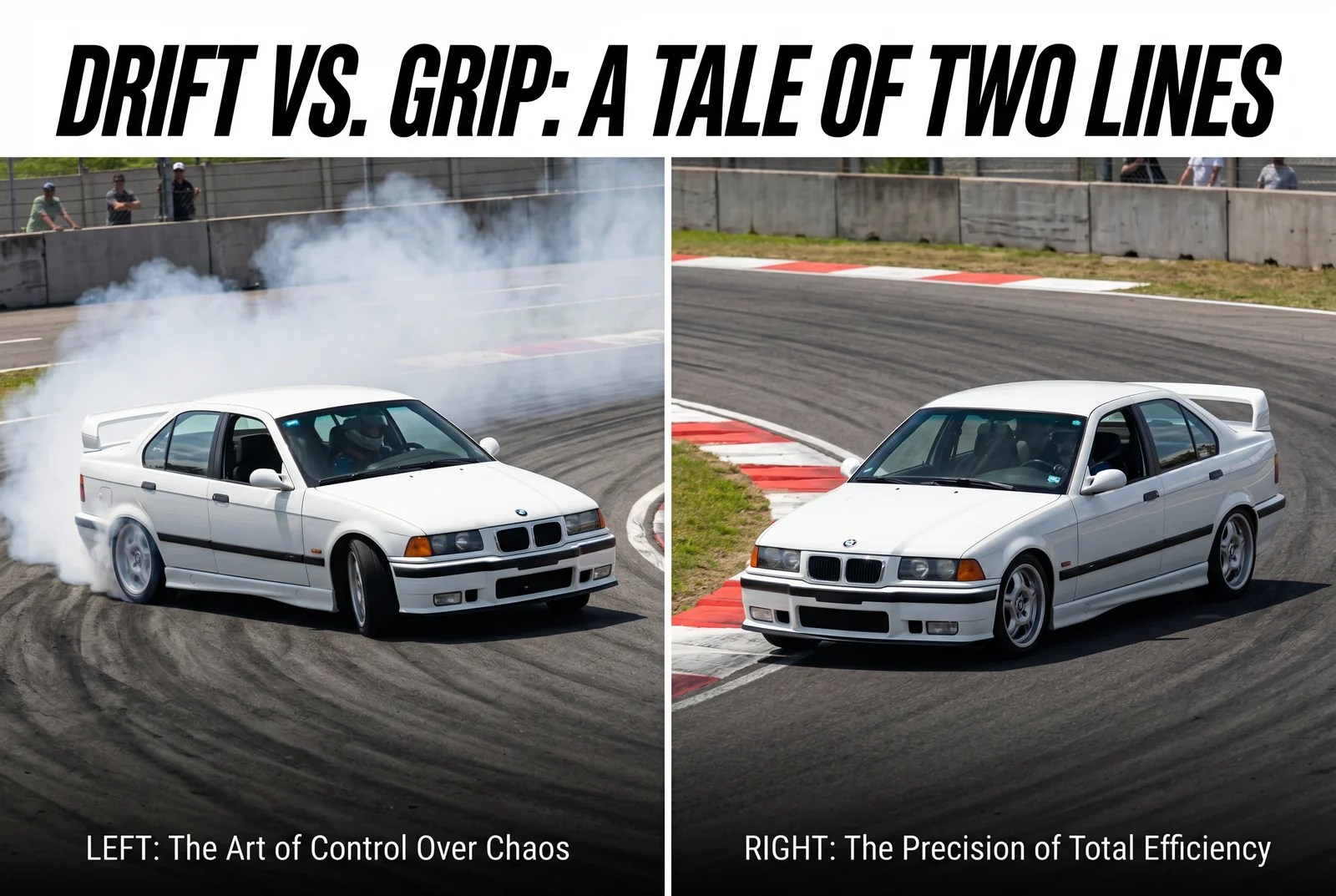
Drifting and performance driving: two worlds, one passion
If you love cars and speed, at some point you will have to choose between learning to drift or learning performance driving. Or rather, you will want to understand how they differ so you know which to try first. Because the truth is they are two completely different disciplines — with different techniques, cars, philosophies and sensations.
This guide compares both from real track-driving experience, not from theory. If you are deciding which to try, here you will find the information you need.
The fundamental difference: grip vs slide
Performance driving (also called grip driving or high-performance driving) aims to lap a circuit in the shortest time possible while keeping the car at the tyre's grip limit. The goal is for the car to never lose traction — if it slides, you lost time. Efficiency is everything: precise braking, optimal racing lines, clean corner exits.
Drifting is exactly the opposite: you deliberately make the car lose rear traction and sustain that controlled oversteer through corners. The goal is not lap time — it is angle, smoke, fluidity and control. Two drift drivers can cover the same circuit and one be clearly better than the other without being faster.
Put simply: in performance driving, the best driver is the fastest. In drifting, the best driver is the most spectacular and controlled.
Techniques and skills
Performance driving
Key skills include: late and precise braking, correct racing line (turn-in point, apex, exit point), fine throttle application on corner exit, reading the circuit to anticipate turns, and consistency lap after lap. The performance driver strives to be smooth, efficient and repeatable. An error of one metre on the line can cost tenths of a second.
The senses developed are speed perception, awareness of braking distances and the ability to maintain concentration over long periods. It is a mental exercise as much as a physical one.
Drifting
Key skills include: oversteer initiation (with throttle, clutch kick or handbrake), proportional counter-steer, angle control with the throttle, transitions between corners and reading the car in real time. A drift driver needs fast reflexes, good coordination and the ability to make decisions in fractions of a second.
The senses developed are tactile perception of the car (feeling traction through the wheel and seat), hand-foot coordination and the ability to react instantly to changing situations. It is more physical and instinctive than performance driving.
Cars and setup
Performance driving
Any car can be used for performance driving: from a city car to a supercar. What matters is that it is mechanically sound and has tyres in good condition. No special modifications are needed to start — a road car at a track day is perfectly viable. At more advanced levels, semi-slick tyres, competition brakes and sport suspension are added.
Drifting
Drifting requires a rear-wheel drive car with specific modifications: a locked differential, dialled-in suspension and tyres prepared for the job. The engine needs plenty of torque to break the rear axle loose and sustain oversteer. You cannot drift seriously in an unmodified road car — which is why the drift school provides the prepared car: a BMW E36 328i with a neat stock cabin, factory seats and factory seatbelt.
Accessibility: which is easier to start
Performance driving is easier to start on your own. You can go to an open track day with your road car, pay the entry fee and turn laps. You do not need an instructor or a special car for the first few sessions. The barrier to entry is low.
Drifting is harder to start on your own because you need a prepared car that most people do not have. But if you go to a drift school with car and instructor included, the barrier disappears: you can drift from the very first session without owning anything.
Paradoxically, drift may be more emotionally accessible for beginners. Within 30 minutes you are doing controlled slides and the adrenaline is immediate. In performance driving, the first sessions are more technical and the satisfaction comes more gradually.
Safety: which is riskier
Both activities are significantly safer than driving on public roads, provided they are practised on a closed circuit with appropriate safety measures.
Performance driving involves higher speeds, which means a mistake can have more serious consequences. A spin at 180 km/h is objectively more dangerous than one at 40 km/h. However, speed circuits have wide run-off areas and barriers designed for those velocities.
Drifting operates at more moderate speeds but with the car in a permanent state of controlled instability. The main risk is a spin (losing control of the oversteer), which at typical drift speeds rarely results in more than a fright and a full rotation. The risk is managed in layers: a private, closed track with no other cars, a professional instructor beside you on every lap, a helmet and a fire extinguisher to regulation, and moderate speeds that you build up at your own pace. It is a controlled environment.
Cost: which is more expensive
If you own a car, performance driving can be cheaper initially: an open track day costs between $50 and $150 USD in Buenos Aires, and you use your own vehicle. But tyre and brake wear is considerable, and if you get hooked you will want semi-slick tyres ($400-800 a set) plus brake and suspension upgrades.
| Track day | Drift (school) | |
|---|---|---|
| Cost to try | $50-150 USD | $300-500 USD |
| Car included | No | Yes |
| Wear on your car | Yes | No |
| Adrenaline | Gradual | Immediate |
Drifting has a higher fixed initial cost if you use a school car ($300-500 USD per session), but you suffer no wear on your own vehicle. If you wanted to build your own drift car, the investment is $15,000-25,000 USD — significantly more than what you need for track days in your road car.
In short: performance driving is cheaper to try, drifting offers a turnkey package that simplifies everything.
The emotional experience
Performance driving gives you the satisfaction of refinement: improving your time by tenths, nailing a braking point to the centimetre, finding the perfect line. It is addictive in a cerebral, progressive way. You leave the circuit mentally replaying every corner.
Drifting gives you a raw, immediate adrenaline rush. The sensation of carrying a car sideways on purpose, with smoke pouring off the tyres and the engine roaring, is visceral. You leave the circuit with trembling hands and a grin that does not fade for hours.
They are complementary experiences, not competing ones. Many drivers do both and say each gives them something the other cannot.
Can you do both? Cross-training
Absolutely. In fact, many professional racing drivers practise drifting to improve their car control, and many drift drivers do speed track days to sharpen their circuit reading.
Drifting improves your performance driving because it teaches you to react when the car loses traction — something that can happen at any moment in a race and needs to be resolved instantly. Performance driving improves your drifting because it teaches you racing lines, braking and circuit vision.
If you must choose one to start, the answer depends on what you are after: if you want immediate adrenaline and a unique experience, start with drifting. If you want to improve your general driving and compete on lap times, start with performance driving. But the honest recommendation is to try both.
Frequently asked questions
Which is harder: drifting or performance driving?
It depends on how you measure difficulty. Drifting has a steeper initial curve because it requires coordinating skills that go against natural instinct (counter-steering, staying on the gas while the car slides). Performance driving is easier to grasp but reaching a competitive level takes longer because differences between drivers are measured in hundredths of a second.
Which is safer?
Neither is zero-risk, but on a closed circuit with appropriate measures both keep the risk in check. Drifting operates at lower speeds, reducing the consequences of a mistake. Performance driving involves higher speeds but the car stays within the grip limit, reducing the probability of error. With an instructor, both are far safer than driving on the road.
Which is more fun?
That depends entirely on the person. Drifting is more spectacular and visceral. Performance driving is more cerebral and rewarding in the long run. The only way to find out is to try both.
Can I drift and do performance driving on the same day?
Technically yes, but it is not ideal. They are disciplines that require different mindsets and it is better to dedicate a separate session to each to get the most out of them. If you have a full day at the track, you can do one session of each with a break in between.
Discover how to learn drifting in Buenos Aires and see our drift school. Interested in track driving? Check out track days vs drift.