Minimum Age for Drifting in Argentina: Requirements and FAQ
 By Dmitrii McCarthy
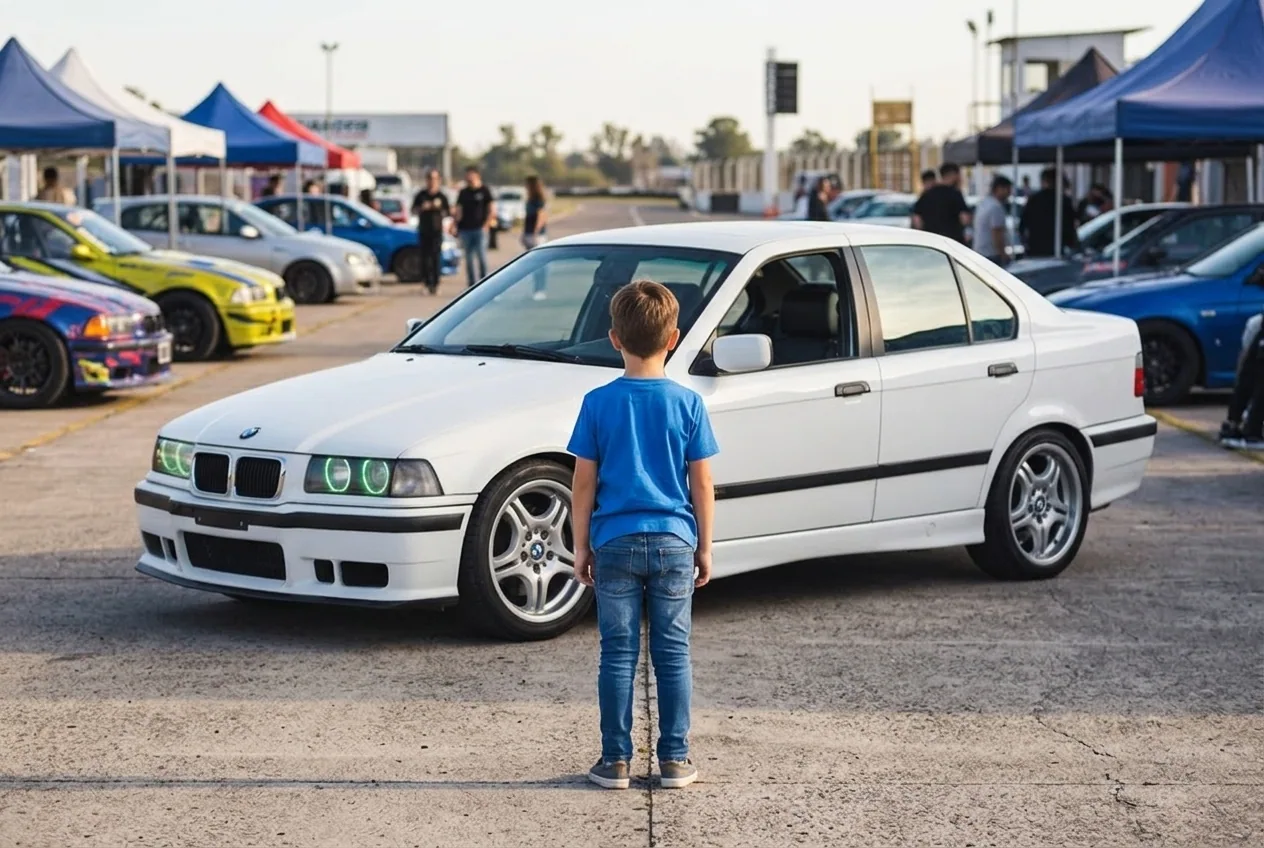
Can minors go drifting? For now, no: neither driving nor as passengers
One of the most frequent questions we receive is about the minimum age for drifting. And it makes sense: if you are a teenager who watched drift videos on YouTube and wants to try, or if you are that teenager's parent and want to know whether it is safe, you need clear and honest information.
The short answer, and it is the house rule: for now it is 18+ only. Until the BMW E36 has dual instructor pedals, we do not put any minor in the car under any condition: not at the wheel, not as a passenger, not with a signed authorisation and not with a parent standing next to the car.
Adults over 18 have conditions too, and it is important that you know them before booking.
Why a driving licence is not required
A driving licence is a requirement for travelling on public roads. A closed circuit is private property with controlled access, where traffic regulations do not apply in the same way. That is why no licence is needed to participate in track activities — not for drifting, not for track days, not for professional karting.
This does not mean anyone can get into a drift car with no conditions whatsoever. It means the decision about who can participate rests with the event organiser or school, not with the traffic authority.
Under-18s: why they do not get in the car today
At the wheel: no, until the car has dual pedals
The BMW E36 is a street car with a manual gearbox and a single set of pedals. If the driver freezes, the instructor can correct with the wheel and with his voice, but he cannot brake or work the clutch for them. That is why, since 10 September 2026, the school rule is clear: nobody under 18 gets in, with no exceptions, until the car has dual instructor pedals. No signed authorisation changes this.
As a passenger: not for now either
The same rule applies to the passenger seat: while the car has no dual instructor pedals, a minor does not ride even as a passenger, even with a parent or legal guardian present. It is not a matter of paperwork or trust: it is the car's setup that does not allow it today.
From 18: basic manual driving
The school's BMW E36 has a manual gearbox. The student needs to know how to use the clutch and shift gears: not be an expert, but be able to start, stop and shift without stalling. If you have never driven a manual car, let us know when you book and we will spend a few extra minutes at the start so you get familiar with the clutch before the drift exercises.
Safety: what measures we take
Safety is the same for every student. This includes:
- Certified helmet: Full-face competition helmet protecting head and neck. We have sizes from XS for smaller heads.
- Seatbelt: The student always wears the seatbelt fastened and adjusted before going out on track.
- Private closed circuit: No other cars, pedestrians or traffic. Everything happens on a controlled track, away from the street.
- Fire extinguisher per regulations: Available trackside as the activity's rules require.
- Permanent instructor: The instructor rides alongside the student for the entire session: guiding and correcting.
We also start with gentle laps before raising the pace, so the first time is a positive one. The student sets the level of slide, and if at any moment they want to stop, we stop.
The parental perspective: common concerns
"Isn't it dangerous for my child to get into a competition car?"
We understand the concern, and that is why today the answer is simple: until the car has dual instructor pedals, a minor does not get in, neither at the wheel nor as a passenger. Once they turn 18, drifting is not a speed race: speeds are moderate (20-50 km/h), the instructor sits beside them on every lap, and the car is a standard street BMW with no roll cage or harnesses, so the class runs within that margin. If what you want is to give them the wheel, the class waits until they turn 18: see the guide to an 18th or 21st birthday gift for my daughter.
"Won't they want to drift on the street afterwards?"
It is a valid concern. Our experience is the opposite: students who learn to drift on a circuit understand the difference between track and street far better than those who have never set foot on a circuit. They know what is needed (prepared car, safety gear, space) and they know the street has none of those things. Learning in a professional environment tends to discourage risky behaviour, not encourage it.
"Is my child too young for this?"
Today there is no debate about maturity or height: for now it is 18+ only, and until the car has dual instructor pedals we do not take minors, neither driving nor as passengers. If your son or daughter is 15 or 16 and loves cars, the honest option is to save our number and keep the class for when they turn 18.
What about older adults? Is there a maximum age?
There is no maximum age for drifting. We have had students aged 60 who enjoyed the experience just as much as those aged 20. The requirements are the same: being able to sit comfortably, reach the pedals and follow instructions.
If you have a medical condition (heart disease, back problems, epilepsy), consult your doctor before booking. Drifting generates lateral forces and moments of intense adrenaline that are not recommended for certain conditions. In practice, the vast majority of adults can drift without any issues.
General physical requirements
Drifting does not require exceptional fitness. You do not need to be an athlete. But there are basic requirements:
- Arm mobility: You need to be able to turn the wheel with range and speed.
- Leg mobility: You need to be able to operate all three pedals with precision.
- Adequate vision: You need to see well with or without glasses (the helmet accommodates spectacles).
- Concentration: You need to be able to follow verbal instructions in real time for 30 to 60 minutes.
There are no specific weight requirements, but the seat and the seatbelt have physical limits. In extreme cases, if a person does not fit comfortably in the seat or the seatbelt cannot be properly adjusted, we will not be able to conduct the session for safety reasons.
Pregnancy
No. Pregnant women cannot participate in drift sessions under any circumstances. The lateral forces, vibrations and physical stress are incompatible with pregnancy. There is no exception to this rule.
How to book
The process is the same for every student:
- Contact us via WhatsApp to arrange date and time (classes run Monday to Thursday)
- Confirm that the person getting in the car is already 18
- You book with a 50% deposit by bank transfer, and the rest is paid at the track on the day of the class
- On the day, the student signs the contract at El Picódromo, Av. Olimpo 80, Esteban Echeverría (see it on Google Maps)
If there is a car-crazy minor in the family, today they cannot get in the car, not even as a passenger. What you can do is keep the class for when they turn 18.
Frequently asked questions
Do I need a driving licence to drift?
No. Since it takes place on a private closed circuit, no licence is required. What you do need is to know how to drive a manual car.
Is there an age limit?
Yes: for now it is 18+ only. Until the car has dual instructor pedals we do not take minors, neither driving nor as passengers. There is no maximum age. See the full requirements, licence and age checklist in a separate article. To learn more about our beginner courses, visit our complete guide.
Is parental consent required?
Consent is not enough: today we do not take minors, neither driving nor as passengers, so neither a signed authorisation nor the presence of a parent or legal guardian allows a minor to get in the car.
What physical conditions are needed?
Normal arm and leg mobility, good vision (with or without glasses) and the concentration to follow instructions. No athletic condition is required. Individuals with heart conditions, epilepsy or severe back problems should consult their doctor. Pregnant women cannot participate.
Can a pregnant person go drifting?
No, under no circumstances. The lateral forces, vibrations and physical stress of drifting are incompatible with pregnancy.
Read about our beginner drift course and how to learn drifting in Buenos Aires.