How to Get Started in Drifting: The Definitive 2026 Guide
 By Dmitrii McCarthy
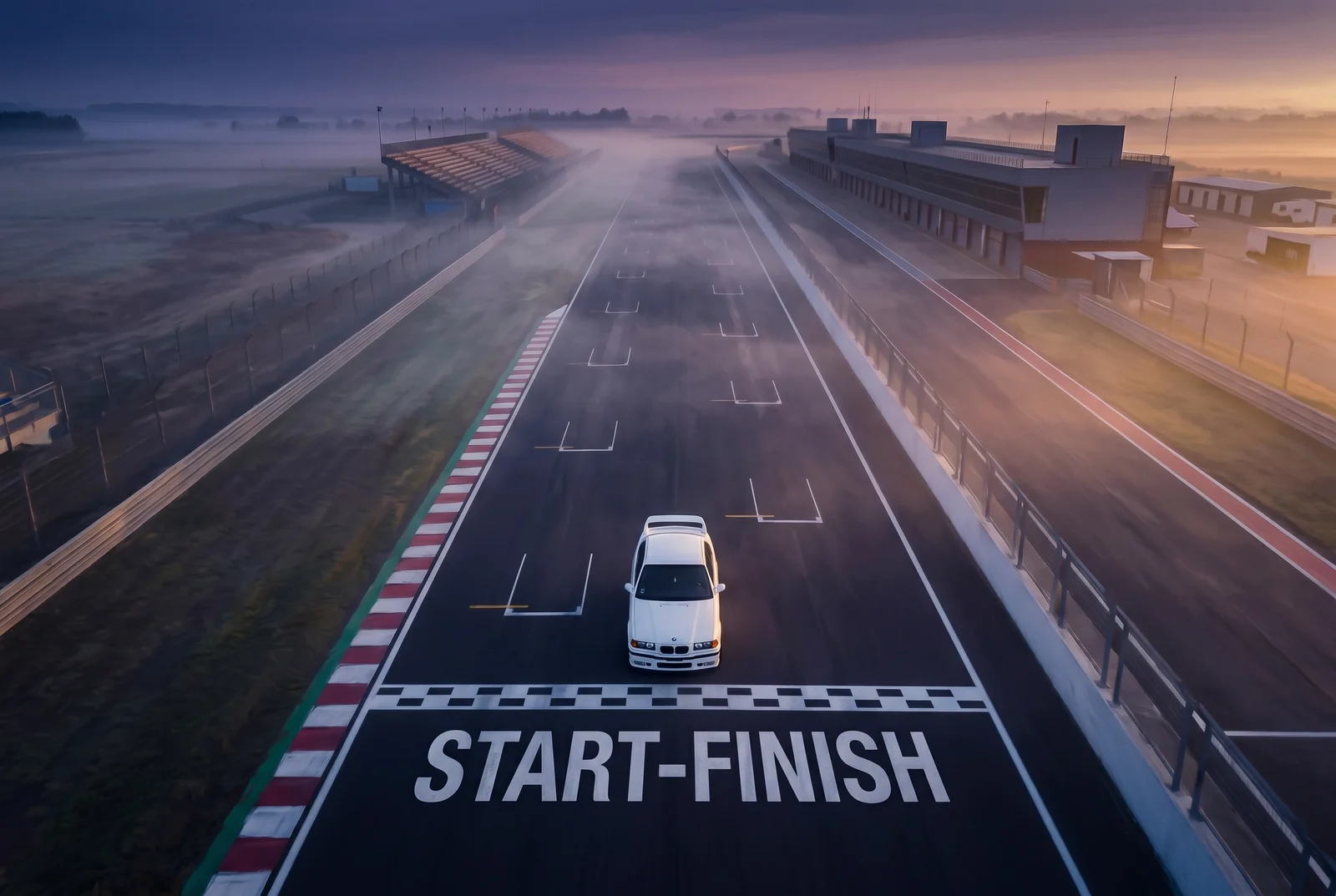
Drift is not what you see in the movies
Forget Tokyo Drift for a second. Real drifting has nothing to do with pulling the handbrake and praying. It is a technical discipline where you control a car in sustained oversteer — the car goes sideways, but you decide exactly where, at what angle, and at what speed.
It is the only motorsport discipline where aesthetics matter as much as speed. The winner is not the one who arrives first, but the one who slides with the most angle, the most smoke, the closest proximity to walls, and the cleanest line.
And the best part: anyone can learn. You do not need to be a professional driver, you do not need a $50,000 car, and you do not need to be young. We have had 55-year-old students, and the only floor is that for now it is 18+ only. Drift does not discriminate.
The car: why the BMW E36 328i is unbeatable for beginners
This is the part everyone wants to know: what car should I buy. The short answer: a BMW E36 328i. Here is the long answer explaining why.
M52 2.8L engine — torque you can actually control
The M52 is a naturally aspirated inline-6 cylinder engine. This means power arrives progressively and predictably. There is no turbo lag, no sudden power spikes that catch you off guard. When you press the throttle, the car responds exactly as you expect it to.
It has plenty of torque to break the rear axle loose, but the delivery is gentle compared to the 500+ HP monsters in Formula Drift, and for learning that is absolutely perfect. With that linear delivery you can hold long drifts without the car getting away from you. Once you master the technique, you can chase more power later.
50/50 weight distribution
The E36 has nearly perfect weight distribution between the front and rear axles. This makes the car neutral — it neither understeers nor oversteers on its own. Oversteer happens when you provoke it intentionally, when you want it.
Compare that to a Mustang (60/40 front-heavy) where the heavy nose makes it unpredictable, or an MR2 (40/60 rear-heavy) where the rear weight can generate sudden snap oversteer. The E36 is balanced and forgiving.
Factory rear-wheel drive
No conversion needed, no strange adaptations. The E36 is RWD from the factory. Engine in front, drive wheels in back, a driveshaft connecting everything. The ideal drift platform.
Mechanically indestructible
The M52 engine is legendarily reliable. There are E36s with 300,000 km that still run perfectly. The ZF manual gearbox is robust, the differential handles the punishment, and spare parts are accessible in Argentina and worldwide.
Accessible price
A decent E36 328i can be found for $5,000 to $10,000 USD in Argentina. Add $5,000-8,000 for drift preparation (suspension, LSD, tires) and you have a competitive car for under $18,000. Nothing else comes close in terms of value for money. If you are torn between the German and the Japanese options, compare BMW E36 vs Nissan: which car to buy for drifting in Argentina.
The minimum preparation for safe drifting
You do not need to spend a fortune, but some things are mandatory:
Adjustable coilover suspension: You need to adjust ride height and stiffness. Stock suspension is too soft for drift. Budget: $500-1,500 USD.
Limited-slip differential (LSD): The factory open differential only sends power to one wheel. For drifting you need both rear wheels spinning. A Kaaz or Cusco LSD costs $400-800 USD. You can also weld the spider gears in the factory diff for $50 — cheap but functional.
A seatbelt that holds you in place: In drift the car moves a lot laterally. If you move in the seat, you cannot control anything. A belt that keeps you planted and a seat that supports you already make a real difference.
Fire extinguisher: Mandatory. $30 USD.
Helmet: Certified, full-face. $100-300 USD.
And the safety layer that matters most is not something you buy: training on a private, closed track with no other cars or traffic, with a professional instructor beside you on every lap, starting slow and building up at your own pace.
The technique: the 5 fundamentals of drifting
1. Initiate oversteer
There are several techniques to make the rear end lose traction:
Clutch kick: You dump the clutch suddenly to make the rear wheels break traction. This is the most common technique and the first one you learn.
Handbrake: You pull the handbrake briefly to lock the rear wheels. Works well at low speed.
Feint (Scandinavian flick): You steer one direction then quickly the other. The weight transfer causes the rear to break loose. It is the most elegant technique.
Power over: You simply floor the throttle in a corner. With enough power, the rear wheels lose traction.
2. Hold the angle
Initiating the drift is the easy part. Holding it is where the art lives. You need to coordinate three things simultaneously: the steering wheel (counter-steer), the throttle (keep the wheels spinning), and your eyes (always look where you want to go, not where you are going).
3. Counter-steer
When the car is going sideways, you turn the steering wheel in the opposite direction of the slide. If the car slides right, the wheel goes left. It sounds counterintuitive but becomes instinctive after 2-3 classes.
4. Throttle control
The throttle controls the drift angle. More gas equals more angle. Less gas and the car straightens out. The secret is being smooth and progressive — never stomp on it suddenly.
5. Transitions
Transitioning from one corner to the next without losing the drift. This is the most difficult technique and what separates good drifters from great ones. It requires mastering weight transfer and timing.
The real budget: how much does it cost to start drifting
Option A: With your own car
BMW E36 328i: $5,000-10,000 USD
Drift preparation: $5,000-8,000 USD
Tires (they wear fast): $200-400 USD per set
Helmet: $100-300 USD
Track day entry: $50-150 USD per day
Total first year: $12,000-20,000 USD
Option B: Classes at our school (no car needed)
Introductory class (30 min): $300 USD
Experience class (60 min): $500 USD
Pro Driver Course (5 sessions of 60 minutes): $2000 USD, $400 USD per session
Option B is ideal if you want to try before buying, or if you do not want to deal with maintenance, tires, and logistics. We provide the car, the instructor, the track, the helmet, and the tires. You just show up and learn.
The most common beginner mistakes
Wanting to go fast before going slow. Drifting is learned at 30-40 km/h, not at 100. Speed comes naturally once you master the technique.
Looking at the car instead of the road. Your body follows your eyes. If you look at the wall, you hit the wall. If you look at the corner exit, the car goes there.
Hitting the brake mid-drift. The brake kills the drift and can cause a spin. If you feel you are losing control, lift off the throttle — do not brake.
Buying a car with too much power. A much more powerful car will not make you a better drifter than a prepared E36 328i. Extra power only amplifies your mistakes.
Not respecting maintenance. Check oil level, engine temperature, tire condition. A prepared E36 is reliable, but not magic.
The drifter mindset
Drifting is 70% mental. You are going sideways at high speed in a car that smells like burning rubber. Your instinct screams to hit the brakes. But if you do, you lose control.
Learning to drift is learning to trust technique over instinct. It is learning that lifting off the throttle is not always the answer. It is learning that the car can go much more sideways than your brain thinks is possible.
The best drifters are not the ones with the most courage. They are the ones with the most calm. Drifting requires surgical precision disguised as controlled chaos.
Your first day on track
Here is what happens when you come to your first class with us:
0-5 min: Briefing. We explain the track, the car, the controls, the instructor signals.
5-10 min: Reconnaissance laps. You drive the track at normal speed to learn the layout.
10-20 min: First slides. The instructor tells you when to clutch-kick, when to pull the handbrake. You start feeling how the car breaks loose.
20-30 min: Repetition. Each attempt gets better. By the end of the class you hold a 2-3 second drift and leave the car with a smile that does not fade for days.
After the first class
Drifting hooks you, and you do not need to be a car fanatic for it to happen (many are not): the feeling of controlling a car in oversteer is addictive in a way that words cannot describe.
The mental side of drifting
Nobody tells you this about drifting: it is profoundly mental. It is not just about turning the wheel and stepping on the gas. It is about reprogramming your instincts. When a car starts to slide, your normal driver brain screams "brake." In drifting, you have to do exactly the opposite: maintain or increase throttle. That reprogramming does not happen in one class — it is a gradual process built session by session.
The best drifters describe a flow state similar to musicians or surfers. You stop thinking about individual actions (steering, gas, brake) and everything becomes one fluid, connected movement. You reach that state after enough hours of practice, when your body already knows what to do and your mind only chooses the line and the style.
That flow state is what hooks people. Not the speed, not the smoke, not the noise. It is the feeling of absolute control over something that looks completely out of control. A paradox that only makes sense when you live it.
Drifting and real life: skills that transfer
Learning to drift does not turn you into a reckless street driver. It makes you a safer driver. Sounds contradictory but the logic is solid: a drifter knows exactly how a car reacts when it loses grip because they practice it hundreds of times in a controlled environment. If your car slides on a rainy day, you will not panic — you will correct automatically because your body already knows how.
You also develop a sensitivity to throttle, steering and brakes that most drivers never acquire. You feel the exact point where the tires are about to lose grip. You feel how weight transfers with every input. That information is always there — but 99% of drivers do not know how to read it.
The drift community in Argentina
Drifting in Argentina is not a solo sport. There is a real and active community, especially in Buenos Aires. WhatsApp groups where people share track days, organize group sessions, buy and sell E36 parts. Instagram accounts dedicated to filming every session. Post-track-day barbecues in the pit lane where everyone reviews videos and shares stories. If you do not live in Buenos Aires, you can get the national picture in the guide to learning to drift in Argentina.
That community matters because it keeps you motivated, helps you progress faster (watching others drift teaches you almost as much as doing it yourself) and connects you with mechanics, builders and other resources you will need if you take drifting seriously.
At our school, the students who progress fastest are the ones who integrate into the community. Not the ones with the most natural talent, but the ones who spend the most time in the environment: watching, asking questions, attending track days as spectators before getting in the car.
Your concrete first step
If you want to take the first step, book your introductory class. $300 USD, 30 minutes, BMW E36, professional instructor, closed circuit in Buenos Aires. No prior experience needed, no car needed, no excuses. You do not need to know anything — literally anything. We teach you everything from zero, at your pace, no pressure.
Read about learning to drift in Buenos Aires, check the minimum age requirements and find out how many classes you need.
Drift is waiting for you.
Frequently Asked Questions
What is the minimum age?
For now it is 18+ only: until the car has dual instructor pedals we do not take minors, neither driving nor as passengers. No driving licence is required: the class runs at El Picódromo, a closed track in Esteban Echeverría (southern Greater Buenos Aires), not on public roads.
What class packages do you offer?
Drift Intro (30 minutes, $300 USD), Drift Experience (60 minutes, $500 USD) and Pro Driver Course (5 sessions of 60 minutes, $2000 USD). Each includes car, instructor, helmet and briefing.