- What types of drift are there?
- The two base formats are solo drift (one car on track running a layout, judged on angle, speed, line and presentation) and tandem drift (two cars at once, one leading and one chasing, replicating line and angle). On top of that come the surface (asphalt, wet track, parking lot or autocross, gravel) and the driving style (aggressive, technical, grip-drift, show), plus the cultural split between competition and lifestyle.
- What is the difference between solo and tandem drifting?
- Solo drifting is the base format: one car on track running a predefined layout, judged on angle, speed, line and presentation. It is where the fundamentals are built. Tandem is two cars at the same time — one leads and the other chases, replicating its line and angle. Technically it is far harder and requires fully mastering solo first.
- Can I learn tandem drifting in my first class?
- No. Tandem is not taught in the Drift Intro or the Drift Experience: it only appears as an advanced option within the Pro Driver Course, generally after session 5 or 6, once the solo drifting fundamentals are mastered. Putting two beginners on the same track at the same time is dangerous for both.
- What type of drifting is taught in the classes?
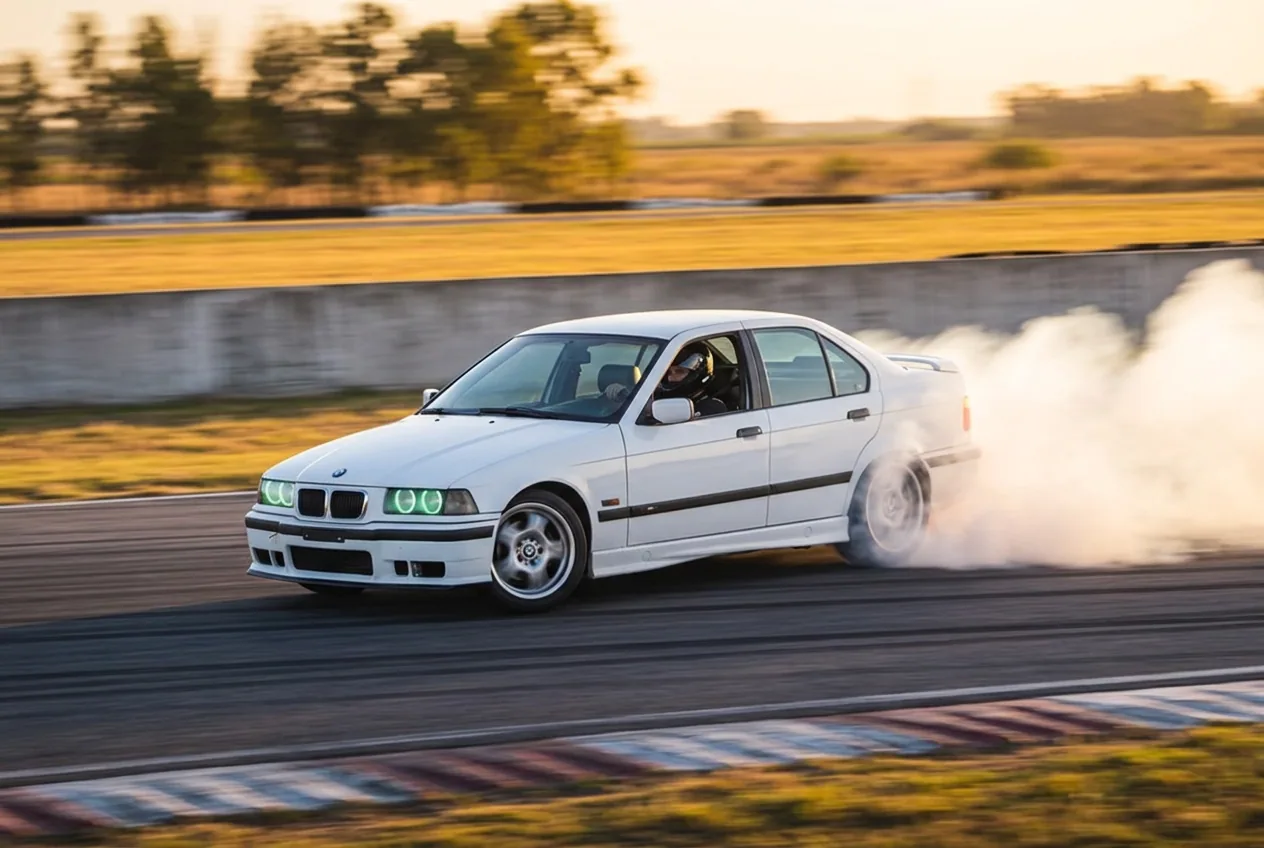
- Solo drifting on an asphalt track, with an instructor in the passenger seat. The car is a drift-prepared BMW E36 328i: rear-wheel drive with plenty of torque to break the rear axle loose, limited-slip differential and dialed-in adjustable coilover suspension. The cabin is clean and stock (factory seats, factory seatbelt). The track is a closed circuit facility in the outskirts of Buenos Aires.
- Which class format should I start with?
- If you want to try it once, the 30-minute Drift Intro at 300 USD is the lowest-commitment choice. If you already know you are interested and want more time at the wheel, the 60-minute Drift Experience at 500 USD adds intermediate techniques. If you want to compete or reach tandem, the Pro Driver Course is 5 sessions of 60 minutes for 2000 USD (400 USD per session).
 By Dmitrii McCarthy