Learning to Drift from Anywhere in Argentina: How to Get to Buenos Aires
 By Dmitrii McCarthy
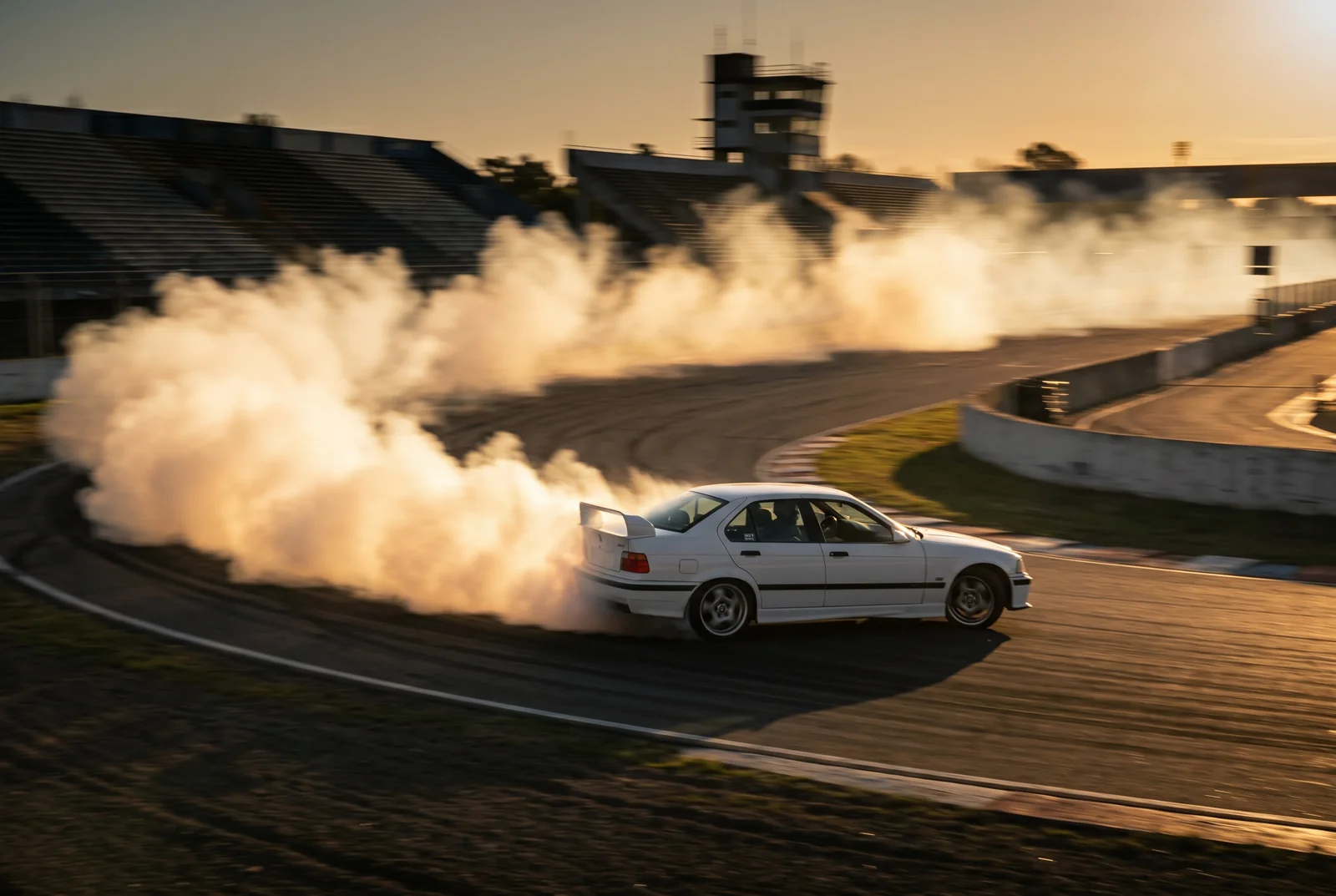
Want to learn drifting? Here is what nobody tells you before you start
Learning to drift in Argentina is more accessible than most people imagine. You do not need your own car, you do not need previous track experience and you do not need to be a natural-born racer. What you do need is to understand the real learning process — because movies and Instagram videos show you the end result but never the road to get there.
This guide comes from the experience of having taught hundreds of students in Buenos Aires. It is not theory pulled from the internet: it is what actually happens when someone gets into a drift car for the first time and starts progressing session after session. If you are already in Buenos Aires city or Greater Buenos Aires, go straight to the guide on how to learn to drift in Buenos Aires.
The real learning curve of drifting
Phase 1: Understanding oversteer (first half hour)
The first thing you learn in drift is how to provoke and control oversteer — the situation where the rear tyres lose traction and the car rotates more than the steering wheel indicates. In everyday driving, oversteer is an emergency. In drift, it is the goal.
With an instructor beside you, within the first 15 minutes you will feel the car break loose and start correcting with counter-steer. It will not be elegant or long, but that first controlled two-second slide is the moment everything changes. Your brain understands it is possible — and it wants more.
Phase 2: Sustaining the slide (hours 1 to 3)
Once you can provoke oversteer, the next challenge is maintaining it. This requires coordinating three things simultaneously: the throttle (which sustains the spin), the steering wheel (which directs the angle) and your eyes (which anticipate the line). It is like learning to ride a bicycle — at first it seems impossible to coordinate everything, then suddenly your body gets it and it flows.
Most students manage to hold a four-to-six-second slide after about three hours of practice spread over two or three sessions. That is the point where drifting stops being a fleeting moment and becomes something you can sustain at will.
Phase 3: Transitions and linking (hours 3 to 8)
Real drifting is not an isolated corner — it is linking several turns without losing the slide. For that you need to master transitions: the moment where you switch from drifting left to drifting right in a fraction of a second. This demands timing, reflexes and a deep understanding of how the car reacts.
It is the phase where most students get frustrated, because transitions are technical and require repetition. But it is also the phase that delivers the biggest reward when it clicks. Linking three corners while keeping the smoke going is a feeling that compares to nothing else.
Phase 4: Style and competition (hour 8 onward)
Once you master transitions, you start developing your own style. Some drivers prefer extreme angles at moderate speeds. Others prioritise speed and keep more conservative angles. At this level you can join drift track days with other drivers and eventually enter amateur competitions.
Why you need a closed circuit
Practising drift on public roads is illegal, dangerous and counter-productive for your learning. A closed circuit gives you what the street cannot: run-off areas if something goes wrong, well-maintained asphalt with no surprises, no traffic and the mental peace to focus on technique without fearing the consequences.
Drifting also wears out tyres quickly. On a circuit with a school car, that wear is covered. On the street in your own car, you are destroying expensive tyres with no learning benefit because you have no instructor, no structured exercises and no way to measure progress.
Why you need a prepared car
A road car is not built for drifting. It lacks a limited-slip differential (without it only one wheel spins and the drift is unstable) and a properly set-up suspension (the car bounces and becomes unpredictable). The school car already comes prepared for exactly this: locked differential, a suspension dialled in and tyres chosen for drifting. And safety does not hinge on any single accessory but on several real layers: you practise on a private, closed circuit (no other cars, no traffic), with the professional instructor beside you on every lap, a helmet on and a fire extinguisher per regulation.
A drift-prepared BMW E36 costs between $15,000 and $25,000 USD. Spending that before you know whether you enjoy drifting would be a terrible decision. The school lets you learn in a professional car without that investment.
Most common beginner mistakes
Looking at the wall instead of the exit
Your car goes where you look. If you are mid-slide and stare at the barrier, you will end up in the barrier. The instructor will repeat a thousand times: "look where you want to go". It sounds simple but under pressure it is the hardest thing to do.
Lifting off the throttle when scared
The natural instinct when something feels out of control is to let go of everything. In drifting, abruptly lifting off the throttle makes the car regain traction suddenly and straighten violently — the dreaded snap oversteer that can end in a spin. The correct response is to reduce gas gradually while correcting with the steering wheel.
Excessive counter-steer
When the car starts sliding, the natural tendency is to crank the wheel all the way in the opposite direction. But if you over-correct, when the car responds it will shoot the other way. Counter-steer needs to be proportional to the angle of the slide — no more, no less. This is learned through practice and instructor guidance.
Wanting to go fast before going well
Many beginners want speed and smoke from the very first lap. But drifting is learned slowly and progressively. First you master control at low speed, then you raise the pace. Skipping stages is the recipe for frustration, scaring the instructor and learning nothing.
How many hours to become competent
Based on our experience with hundreds of students:
- 30 minutes: First controlled slide. Understanding what oversteer is.
- 2-3 hours: Holding four-to-six-second slides in a single corner. Basic angle and speed control.
- 5-8 hours: Linking two or three corners while drifting. Basic transitions.
- 10-15 hours: Drifting a full circuit. Personal style. Ready for track days.
- 20+ hours: Amateur competition level. Tandem runs with other drivers.
These numbers vary by individual. Some progress faster, others slower. The key point is that virtually everyone reaches the "enjoy a track day" level within ten to fifteen hours.
Where to learn drifting in Buenos Aires
At Racing Rental we run a drift school in Buenos Aires with a professional instructor, a prepared BMW E36 and a closed circuit. Sessions start at $300 USD for 30 minutes and no previous experience is required. The instructor adapts to your level from the very first minute.
Coming from the interior? How to plan the trip to Buenos Aires
If you live in Cordoba, Mendoza, Rosario, Tucuman or any other province, the realistic plan is the same: travel to Buenos Aires. The track is 40-50 minutes from CABA, so once you are in the city the final leg is short — when you confirm your booking we send you the exact location on WhatsApp with directions.
The packages are designed so you do not have to relocate: the 30-minute Drift Intro ($300 USD) and the 60-minute Drift Experience ($500 USD) fit perfectly into a 1 or 2 day getaway. You arrive, take the class, and the rest of the day is yours — an ideal format to combine with a weekend in the city.
And if you do not yet know when you will be able to travel, no problem: the reservation is valid for 12 months, so you can pay now and coordinate the exact date on WhatsApp once your trip is set. That flexibility exists precisely for people coming from far away.
Frequently asked questions
How long does it take to learn to drift?
You will get your first controlled slide within 30 minutes. To feel comfortable linking corners you need between five and eight hours of practice. For amateur competition level, around 20 hours.
Do I need my own car?
No. It is actually better to start in a school car built for drifting. You save the investment of preparing a car and learn in a safe, predictable vehicle. If after several sessions you decide you want your own drift car, the instructor can advise you.
Can I practise drift on the street?
No, and you should not. It is illegal, dangerous and you will not learn anything useful. A closed circuit with an instructor is the only responsible and effective way to learn.
What is the minimum age to learn?
There is no strict minimum age because practice takes place on a closed circuit, not on public roads. Minors need authorisation from a responsible adult. You can read more in our article on minimum age for drifting.
Find out how many drift lessons you need and read the definitive guide to getting started with drifting. More in our complete guide on how to learn drifting in Buenos Aires.