What If I Break the Car in a Drift Class? The Damage Policy, No Fine Print
 By Dmitrii McCarthy
Why this is the number-one question before booking
Of all the questions we get, this is the one that stops people the most: "what if I break the car?". It is logical and it is healthy to ask it. You are about to get into a car that is not yours, to do something that looks violent, and the fear is not getting hurt — the track and the gear cover that — the fear is the bill that might land afterward. Nobody wants to end a great day with a surprise invoice for thousands of dollars.
So let us talk about it head-on, no spin and no marketing. In this article we explain exactly how the damage policy works: what is included and you do not pay, what happens if something serious breaks, why you sign a contract, and why the real statistics are far calmer than fear makes you believe. We are not going to throw damage figures into the air — those are in the contract, and we send them to you via WhatsApp before you decide — but we will be clear about the mechanism. If you still have a single doubt after reading this, you resolve it in thirty seconds by message.
One clarification so we do not repeat ourselves: we are not covering class prices here. If what you want is how much each format costs and what it includes, that is in the guide to how much a drift class costs. This article is only about damage and responsibility.
What is included and you pay nothing extra
First and most important: drift wears things out. It is part of the game. When a car slides, it eats rubber, heats the brakes, burns fuel and works the clutch. All of that is known in advance and is built into the class price. It is not an extra that appears at the end. It is the normal operation of drifting, and it is on us.
Concretely, this is in the price and you do not pay for it:
- Tires: drift eats rubber, that is the nature of the sport. The tire wear during your class is included.
- Brakes: the normal use of pads and discs during the session is on us.
- Fuel: the fuel burned in your class is already in the price.
- Clutch: the normal clutch wear inherent to the operation is covered.
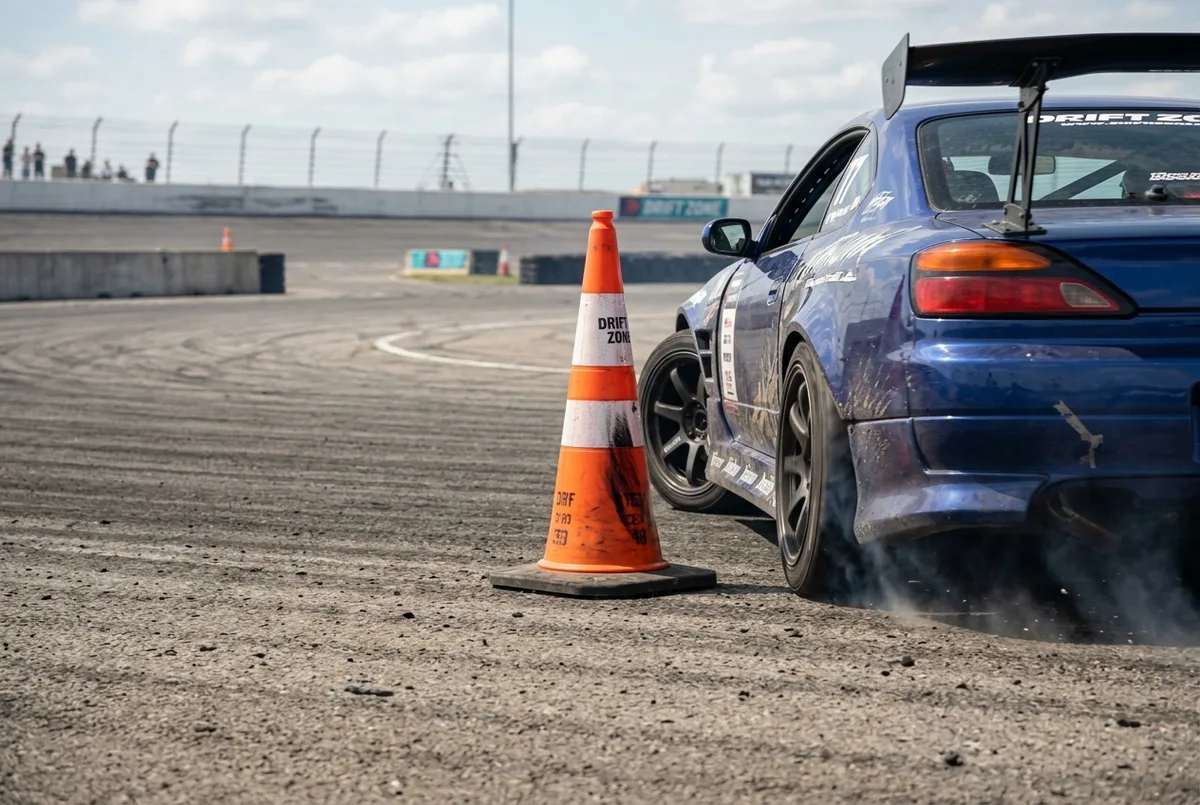
- Light cone contact: clipping a cone in a transition is part of learning, not damage. That is not charged.
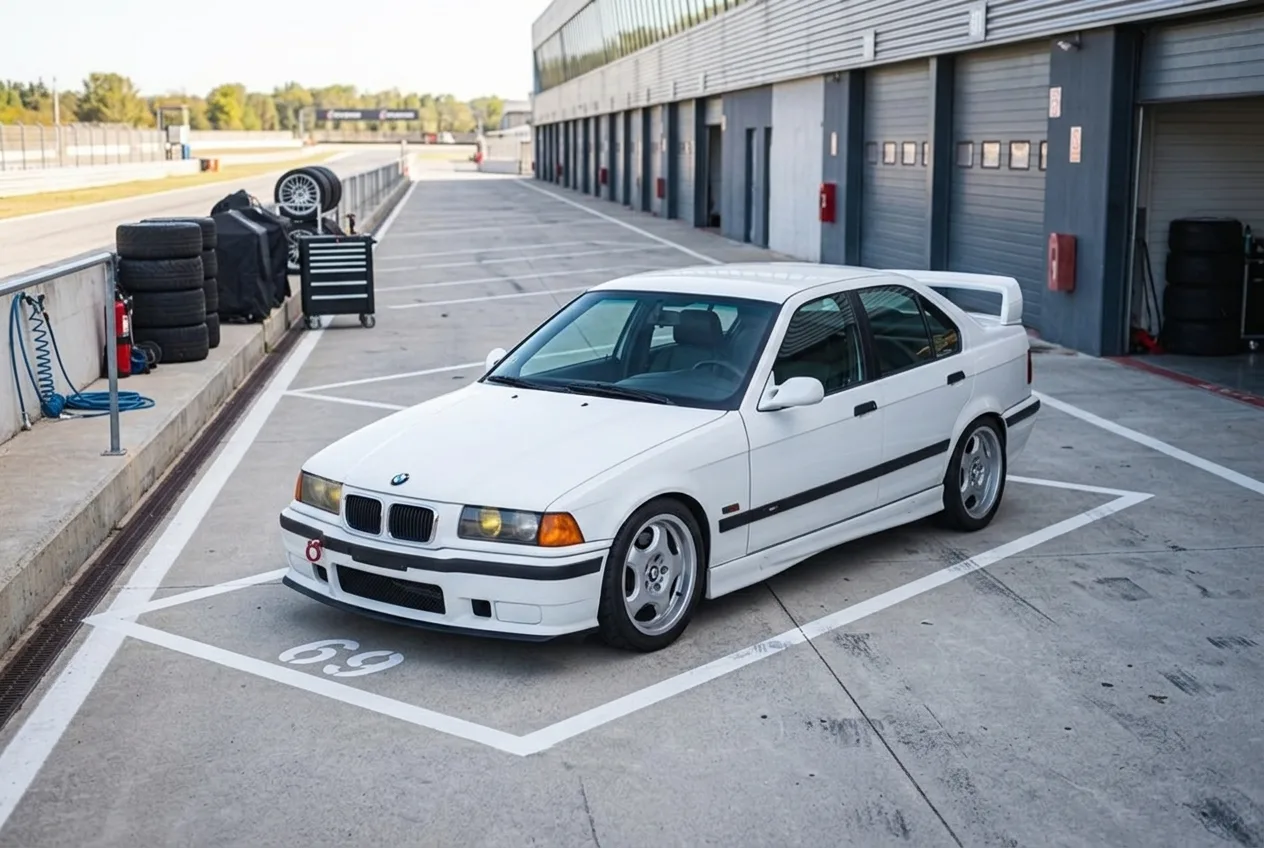
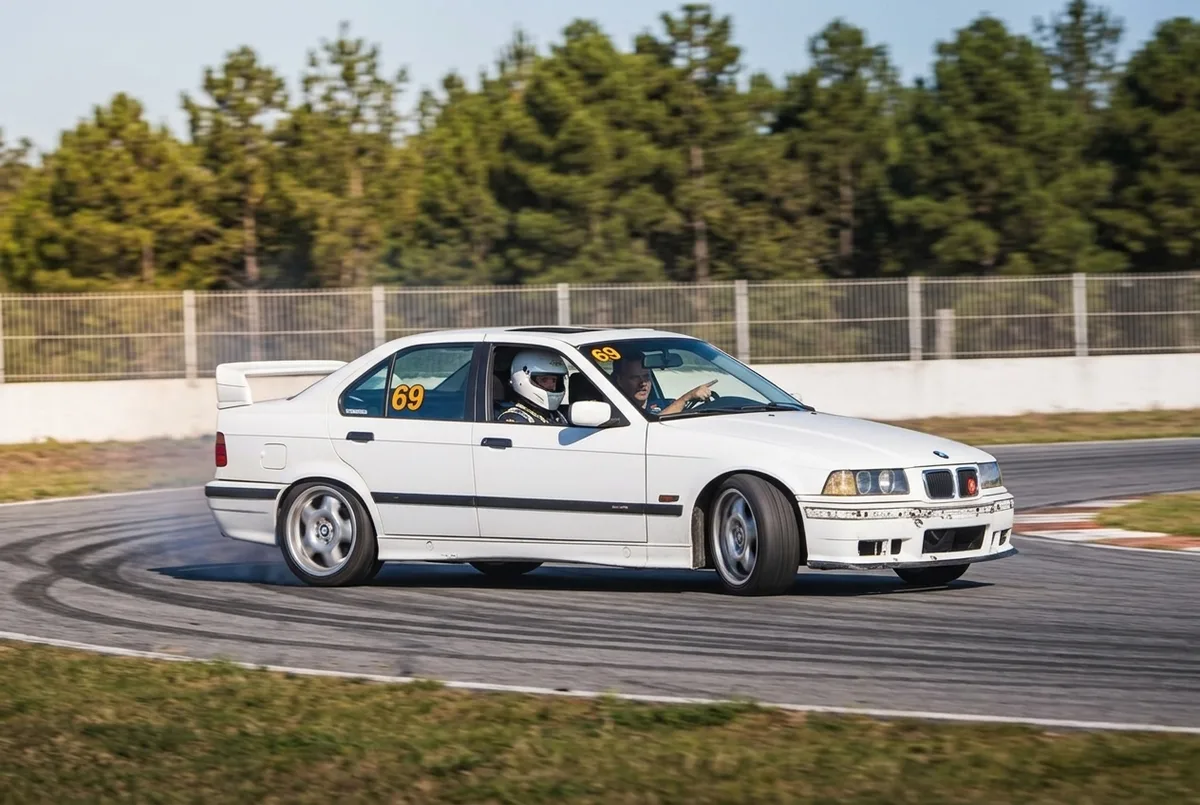
In other words: everything that wears out because the car is doing its job is on us. The car is our work tool, not a fragile collector car we handle with white gloves. It is prepared so you can use it hard: a BMW E36 328i with a locked differential, dialed-in suspension and tires meant for this. It is built for drift, and you use it on a private, closed track, with the professional instructor beside you on every lap and a helmet on.
What happens with serious damage
Now the part that really worries you: what if I break something big, not a cone, but a part? Here is the mechanism, and it is the exact opposite of fine print.
Every component that could break through misuse has a pre-set, fixed cost, already written in the contract you sign before getting in. It is not a number we invent after something happens. It is not "we will assess it and let you know". It is a closed list: you know in advance how much each thing costs, before you touch the wheel. That is the whole idea — zero surprises.
By deliberate choice, we do not publish those figures in a blog post: they depend on the component and we want you to read them in context, in the contract, not as a loose headline that scares without explaining. The amounts are detailed in the contract you sign, and we send them to you via WhatsApp before you book, so you decide with all the information on the table. Ask and we send you the full detail on the spot.
The responsibility: you break it, you pay it
The model is simple and we say it without makeup: you break it, you pay it. While you are at the wheel, you take responsibility for the car. But read it well, because it is fairer than it sounds at first.
It is fair for three reasons. First: you know exactly how much each thing costs before getting in, because it is on the contract list. There is no surprise or figure invented afterward. Second: normal wear is on us — you only take charge of what breaks through misuse, not what wears because the car is working. And third: in practice, you drive a car treating it as if it were yours, with an instructor beside you who is precisely there so you never get to break it.
Here is a point many people do not know and that is worth being clear about: you cannot lean on your personal auto insurance for this. Standard auto policies in the Argentine market exclude track, competition or circuit use. It is a common exclusion in ordinary policy wording — it is not something of ours, it is how personal auto insurance generally works. That is why the mechanism is not insurance: it is the contract. The contract with fixed, pre-listed costs is precisely what replaces the coverage your personal policy does not give you. You know where you stand from the start, in writing.
Why we use our car and not yours
A question that comes up often: "can I learn with my own car?". The short answer is that for the class we use our prepared BMW E36, and that actually protects you.
Think about it: learning to drift means making mistakes. You will stall, you will overshoot the angle, you will correct late. It is a normal part of the learning curve. If that happens with your car, you break your car — your engine, your gearbox, your bodywork, and on top of that without the setup a car prepared for drift has. With our car, you learn on a tool prepared specifically to withstand those mistakes: a locked differential, dialed-in suspension and tires meant for this. And you do it on a private, closed track, with the professional instructor beside you on every lap. You are not risking your assets while you learn the basics.
Also, a car prepared for drift is very different from a street car. It has a locked differential, geometry designed for angle, and everything set up so the slide is predictable. Learning on the right tool is safer and faster than fighting a street car that is not made for this. If the car itself interests you, we go deeper in the article on whether you can drift with an automatic car.
The contract you sign before getting in
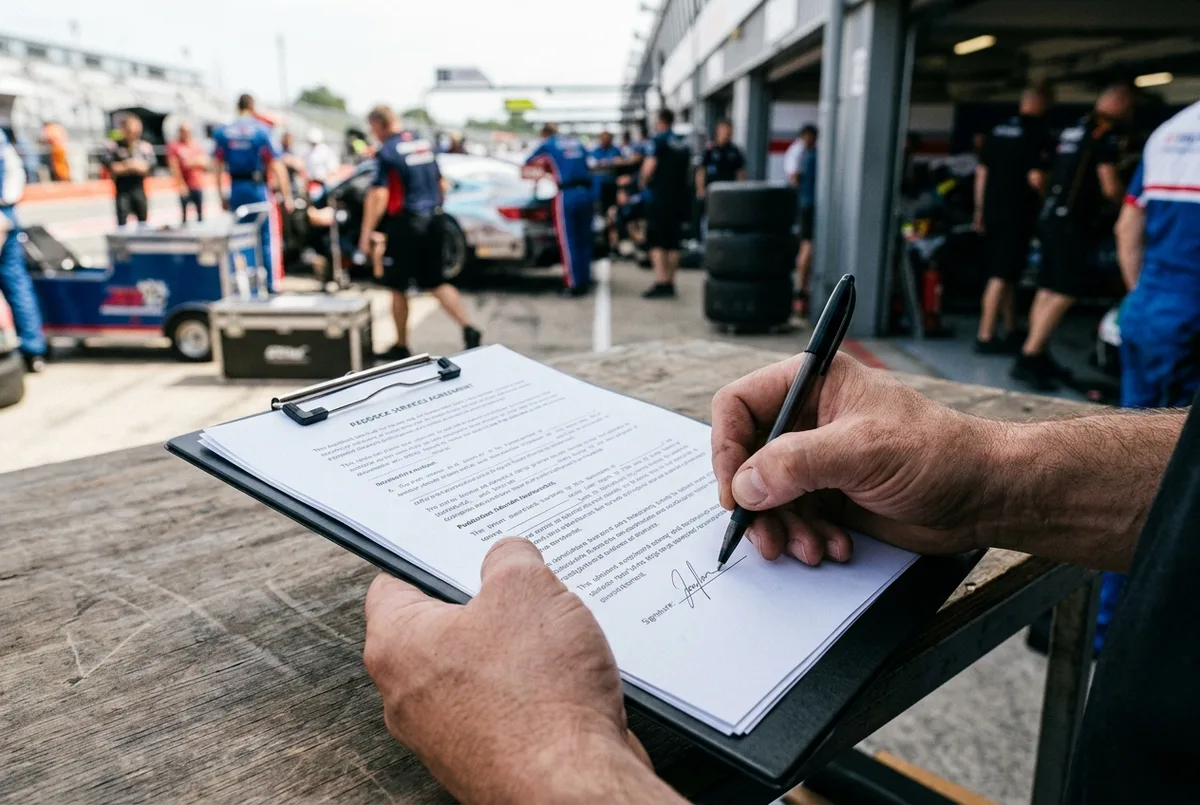
Before each class you sign a track contract. It is not a formality to scare you — it is precisely what puts everything in black and white so there are no misunderstandings later. Without it, "you break it, you pay it" would be an awkward conversation at the end of the day. With the contract, everything is clear before you even start.
In general terms, the contract does three things: it acknowledges that drift is a risk activity and that you are doing it in an informed way; it details the damages that can occur and the fixed cost associated with each; and it puts your responsibility for the car during the class in writing. It is standard for any serious track activity. We are not going to quote clauses verbatim here because we send you the full document to read calmly — the idea is that you arrive on class day with no surprise, having read and accepted everything in advance.
The document required to sign it is simple: your DNI or passport. You do not need a driver's license, because the class is on a closed private circuit, not on public roads.
The statistical reality: serious damage is extremely rare
After all the theory, it is worth landing on real numbers, because fear distorts. The probability that you break something serious in your first class is very low, and it is no accident: it is designed to be that way.
The professional instructor sits beside you, in the passenger seat, throughout the class. They guide you, correct you and can take control if needed. That means that at any maneuver starting to get out of control, the instructor intervenes before the mistake turns into a hit. Add that speeds are moderate — you start slow and build up at your own pace, drift is not a speed race — and that the track is private and closed, with no other cars, pedestrians or traffic.
The concrete result: the risk is managed in layers, in a controlled environment. The combination of a prepared car with dialed-in suspension, a professional instructor beside you who can take control, a private and closed track, a helmet and a fire extinguisher per regulation is precisely what makes the question "what if I break it?" have, in practice, a reassuring answer: it almost never happens, and when something minor happens, you already know in advance how much it costs.
Let us talk before you book
If you made it this far, you probably already have the answer you were looking for: the wear is on us, anything you break through misuse has a fixed price you see before getting in, and the statistics are on your side. The natural last step is to ask for the damage detail and the contract to read with your own eyes.
Message us on WhatsApp and we send you the full damage policy and the contract, with no commitment to book. We want you to decide with all the information. Ask us for the damage policy and the contract via WhatsApp here, or directly at +54 9 11 6833-3342, in Buenos Aires.
And if you are already at ease and want to move forward, book your drift class here. The track is in the outskirts of Buenos Aires and the exact location reaches you upon confirmation.
To keep clearing doubts, here are the articles that help a first-timer most: what to expect from your first drift class (where we also talk about the fear of breaking things), how much a class costs and the pillar guide on how to learn to drift in Buenos Aires.
Frequently Asked Questions
Do I pay anything if I touch a cone?
No. Lightly clipping a cone in a transition is a normal part of learning, not damage. It is not charged. Same with the wear of tires, brakes, fuel and clutch: all of that is included in the class price.
And if I break something big, a part?
Every component that can break through misuse has a fixed cost, already listed in the contract you sign before getting in. You know the number in advance, no surprises. We do not publish those figures on the blog because they depend on the component — we send them to you via WhatsApp before booking so you decide with everything clear.
Does my personal auto insurance cover me?
No. Standard auto policies in Argentina exclude track, competition or circuit use. That is why the mechanism is not insurance but a contract with fixed, pre-listed costs, which is exactly what replaces the coverage your personal policy does not give you.
Can I bring my own car instead of using yours?
For the class we use our prepared BMW E36, and that protects you: you learn on a tool built to withstand mistakes, without risking your own car or engine while you make errors on the learning curve. More on the car in the article on whether you can drift with an automatic car.