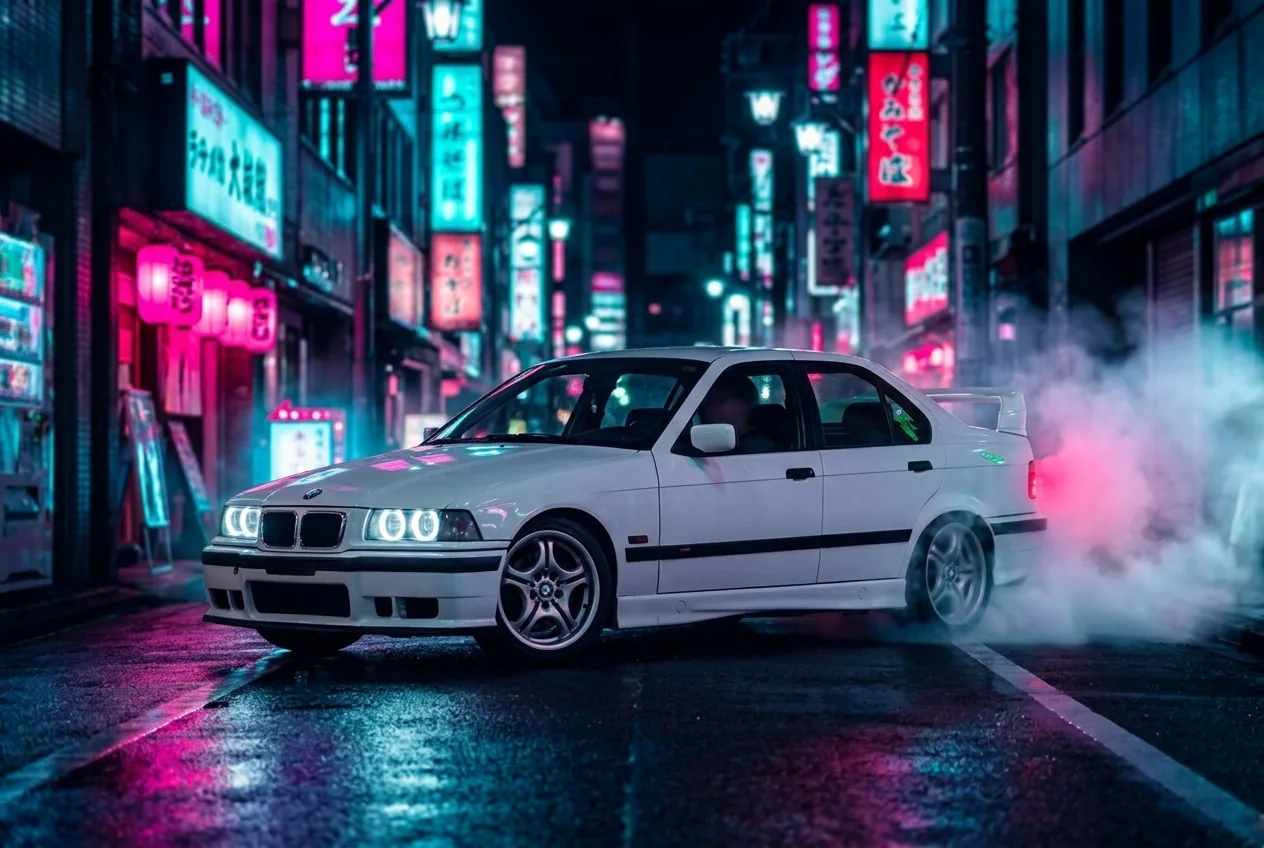
Tokyo Drift: what is real and what is fiction (and how to actually drift)
By Dmitrii McCarthy
Tokyo Drift: what is real and what is fiction
The drift you saw in the movies is real as a technique — cars really do go sideways on purpose, with the rear wheels spinning, controlled by the driver. What the films exaggerate is the speed, the danger and the idea of learning alone on the street. Real drift happens at around 20-50 km/h, on a closed private track, with a professional instructor riding shotgun. This article is currently available in Spanish; a native English version is coming soon.
The technique is real: cars go sideways on purpose, with the rear wheels spinning, controlled by the driver. What the movies exaggerate is the speed, the danger and the idea of learning alone on the street. Real drift happens at around 20-50 km/h, on a closed track and with an instructor.
At what speed do you actually drift?
Around 20-50 km/h, not flat out. Drift is about angle and control, not top speed. That moderate speed is what lets you focus on technique, on a closed circuit with no traffic.
Can I drift like in the movies without experience?
Yes. The method starts from zero and a professional instructor rides as co-pilot guiding you in real time. Many students get their first slides the same day. No license needed because it is a closed circuit, and no car of your own because you use the school's BMW E36.
Where can I try real drift in Buenos Aires?
At El Picódromo, a private, closed circuit at Av. Olimpo 80, Esteban Echeverría (south of Greater Buenos Aires). The 30-minute Drift Intro starts at 300 USD with everything included. You coordinate via WhatsApp at +54 9 11 6833-3342. Location on Google Maps: https://maps.app.goo.gl/Wc6edGAhDxve8WBw7
Reading about it is one thing, driving it is another
Try it yourself: 30 min at the wheel, no experience needed. From 300 USD (≈477,000 ARS at the P2P dollar rate), Monday to Thursday. 1-on-1 instructor in a BMW E36 and a 50% deposit to book.
 By Dmitrii McCarthy