- What is traction control for?
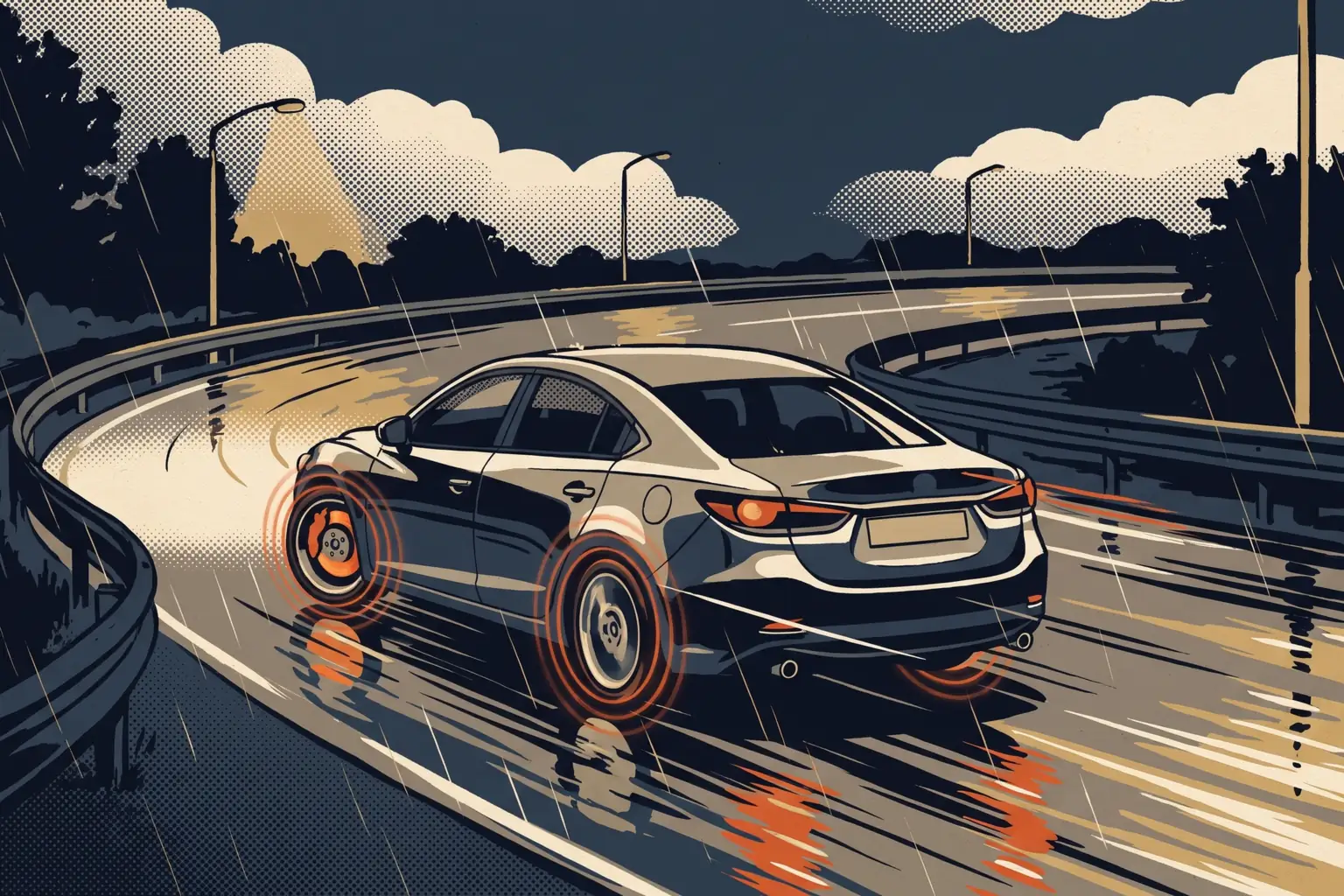
- To keep the wheels that receive engine power from spinning when you accelerate. If one turns much faster than the others, the system cuts engine power or brakes that wheel until it grips again. It does not add grip to the car: it trims whatever the throttle asks for beyond it.
- What is the difference between traction control and stability control?
- Traction control only checks whether the driven wheels spin when you accelerate. Stability control (ESP or ESC) compares where the steering wheel points with where the car is going and brakes individual wheels to correct oversteer or understeer, whether you are accelerating, braking or cornering. Every car with stability control also has traction control.
- What does the traction control light mean?
- If it flashes while you drive, the system is working: slow down and do not accelerate. If it stays on, there may be a fault and it should be checked. If the light with the word OFF comes on, the system is switched off. Every brand uses its own symbol, so check your owner's manual.
- Is it bad to drive with traction control off?
- On the road you lose an aid that exists to prevent skids. The Hyundai owner's manual we cite keeps the off mode for one case: freeing the car when it is stuck in mud or snow, and only briefly. In general, the system switches itself back on when you restart the engine.
- Is stability control mandatory in Argentina?
- Yes, for new vehicles: since 1 January 2022 it has been required on every model sold in the country, with specific exceptions for some light utility vehicles and heavy vehicles. The rule does not require adding it to cars that were already on the road.
- What is traction control for on a motorcycle?
- For the same thing as in a car: keeping the driven wheel, the rear one, from spinning when you accelerate. On road bikes it was already around in the early 1990s: Honda offered it as an option, alongside ABS, on the ST1100.
 By Dmitrii McCarthy