Is Drifting Dangerous? A Drift Class Safety System, Layer by Layer
 By Dmitrii McCarthy
Where the fear of drifting comes from
If you made it this far, something is pulling you to do it, but another part of you holds back with a reasonable question: "isn't this dangerous?". That is a healthy question. And the honest answer is that the risk is never zero — but the real risk of a class is far lower than you imagine, because almost everything you imagine comes from the wrong place.
Dmitrii McCarthy, instructor: «The fear the first time is normal and even healthy. That is why I ride in the seat next to you and can take control if needed: you learn to lose control little by little, in a place where nothing bad can happen.»
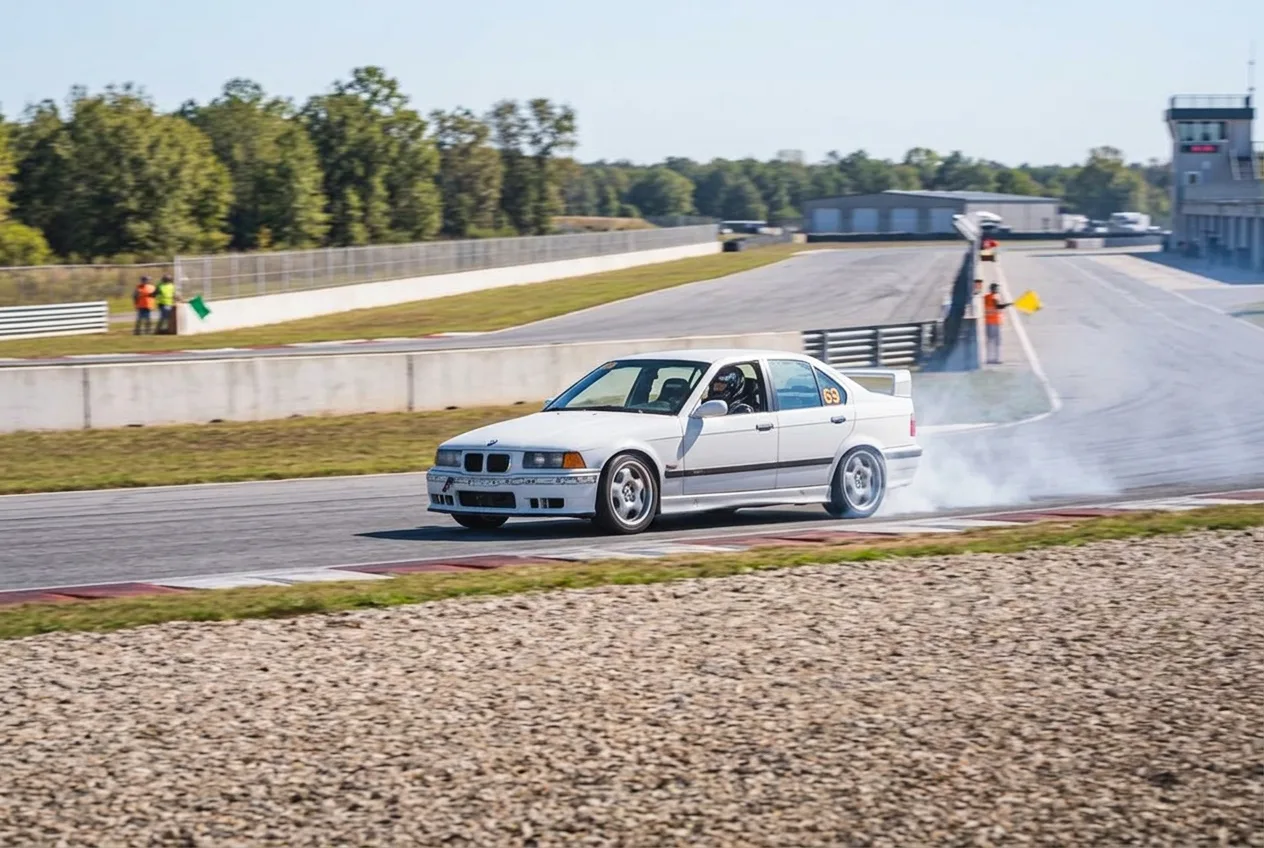
Fear almost always feeds on two sources. The first is culture: you watched Initial D, you saw videos of cars sliding on the edge of a cliff, you saw edits with epic music where everything looks one millimeter from disaster. The second, worse, are street-crash videos: kids doing donuts on an avenue that end against a curb, a pole, or worse. That is what your head files away as "drift".
But none of that is a class on a closed track. An illegal street slide and a class with an instructor on a private circuit are as similar as a street race and a timed lap at a circuit: the maneuver rhymes, the risk context has nothing to do with it. What follows is how that risk is managed, layer by layer, so you decide with information and not with a movie image.
The 5 safety layers of a class
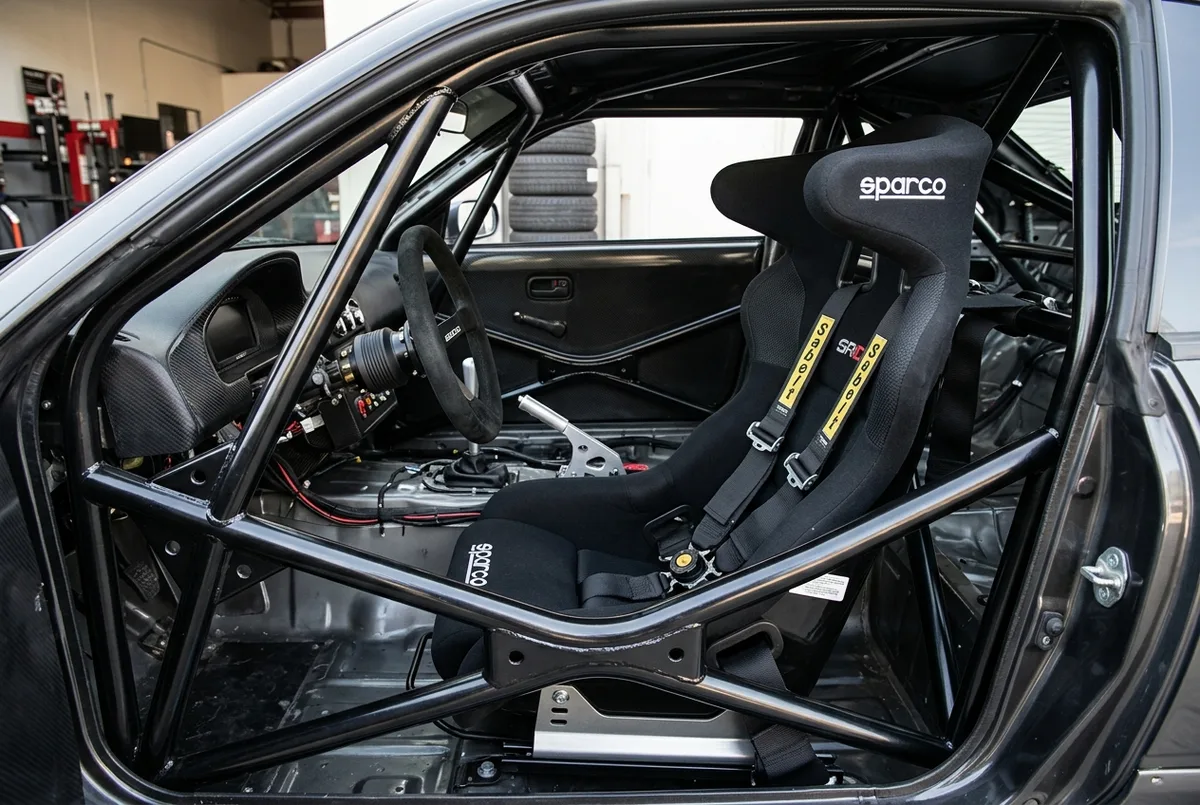
A Drift School class's safety is not a single thing: it is 5 layers that back each other up. If one fails, the next holds. This is how a class is built.
Layer 1 — The prepared car
You do not drift in an ordinary street car. The tool is a rear-wheel-drive BMW E36 328i prepared specifically for this: a locked differential, suspension dialed in, and tires meant for drift. The cabin is stock and tidy: factory seats, factory seatbelt, and stock dashboard. It is a work tool, not a fragile collector car. It is built to take the intense use of one class after another, and to respond predictably when you push it to the limit.
A car that is properly prepared, with its suspension dialed in, is key: it reacts in a predictable, forgiving way, with no strange surprises. That, beyond safety, is control: a car that responds the way you expect lets you feel better what it is doing while you learn.
Layer 2 — The gear
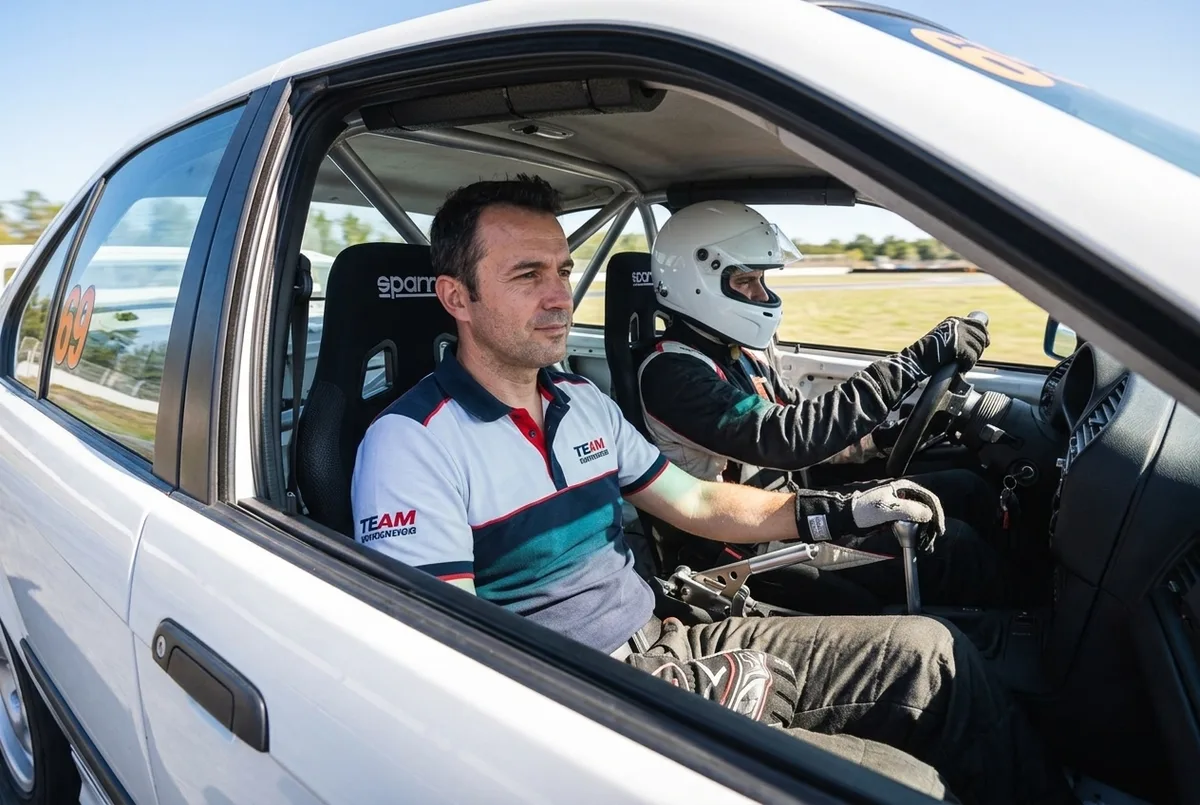
Before starting we put a full-face competition-certified helmet on you. "Full-face" means it protects the whole head and face, not a half helmet. "Competition-certified" means it meets the safety standards for track use, not a decorative helmet. The helmet is included in the class: you do not need to bring anything.
Layer 3 — The co-pilot instructor
This is, for most people, the layer that reassures the most. You are never alone in the car. A professional instructor sits in the passenger seat for the entire class, and he is not there for decoration: he is beside you on every lap, guides you, and can brake and take control if needed. If something gets complicated, it does not depend only on your beginner reflexes — the instructor can intervene in a fraction of a second.
In practice, this changes everything. You drive, feel and learn, but there is a net below. The instructor guides you with his voice, tells you when to give gas and when to release, and has the last physical word over the car if needed. It is one-on-one: all his attention is on you and that car, not split among ten students.
Layer 4 — The track
We run on a closed private track, in the outskirts of Buenos Aires. "Closed" means there is no crossing traffic, no pedestrians, no parked cars, no concrete curbs waiting for a mistake. The layout has wide run-off margins: if the car leaves the line, it goes toward a gravel area, not against concrete. A mistake that on the street ends against something, on the track ends in a zone designed to absorb it.
We send you the exact location via WhatsApp once the booking is confirmed, because it is a track we coordinate specifically for the class. This gives us full control over the conditions: the whole environment is set up so that learning is safe.
Layer 5 — Moderate speed
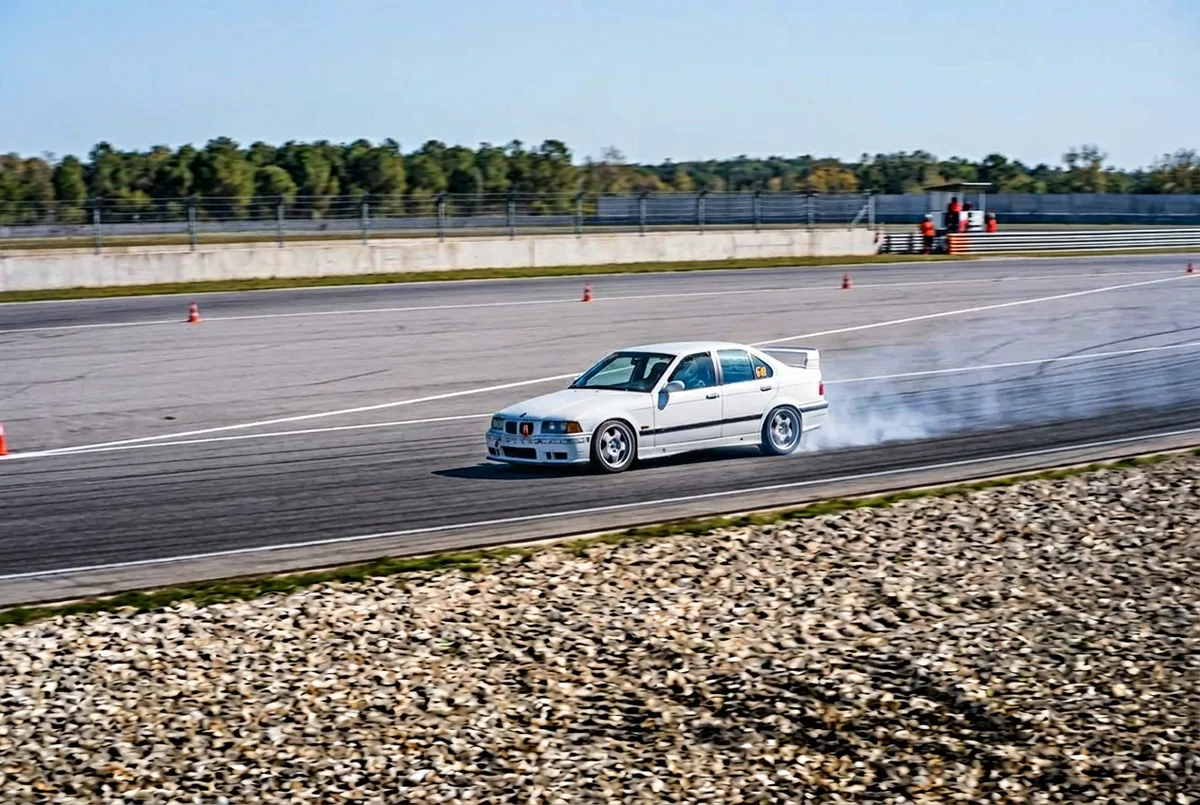
Here is the biggest misunderstanding: people think drifting is going super fast. It is not. Drift is not a speed race — it is car control in a slide. In a learning class the speeds are moderate, in the 20-50 km/h range. That is less than you do on any city avenue. The point is not top speed; it is angle, control and transition. And learning at that pace is exactly what makes it manageable for a beginner.
Learning on track is safer than the street
Learning on Drift School's closed track, in the outskirts of Buenos Aires, is statistically far safer than driving on the street, and it is worth flipping this because it changes the whole frame. The question should not be "is it dangerous to drift on a closed track?" but "compared to what?". And compared to driving on the street, closed-track motorsport is statistically far safer: the environment is controlled, there is no oncoming traffic, everyone there knows what is going to happen, and there are run-off areas designed for mistakes.
Think about it: every time you go out on the road, other drivers, the weather, a pothole, someone looking at their phone all expose you. On a closed track none of that exists. That is why learning to control a car in a slide — in a closed environment, with an instructor beside you and all the gear — is one of the safest ways there is to raise your real level at the wheel. Driving on a closed track, with safety rules, is safer than improvising on the road.
And here is the concrete part, without inflating anything: the risk is managed in layers and it is a controlled environment, built so a beginner can learn safely. It is not magic: it is exactly the result of stacking the 5 layers above.
What if I get dizzy or scared in the car?
Getting dizzy or scared in the BMW E36 is totally normal — especially in the first minutes, when your body still does not understand the lateral forces — and if you want to stop, we stop. There is no problem with that, and no obligation to tough it out. If at any point you get dizzy, overwhelmed or simply want to stop: we stop. You get out, drink water, breathe for a few minutes, and when you are ready, we continue. The class is yours and goes at your pace, not the other way around.
That is exactly the advantage of the one-on-one format: the instructor reads you, sees if you are tense or dizzy and adjusts. Nobody pushes you to do something you are not ready for. If you want to know in detail how it feels minute by minute on the first day, we cover it in the article on what to expect from your first drift class.
Book with a clear head
A Drift School class's risk is managed in 5 layers — prepared car, certified gear, an instructor beside you who can take control, closed track and moderate speed — even though drifting will never have zero risk, as no physical activity does. And now you know that learning this way is safer than driving on the everyday road. The decision stops being a blind leap and becomes an informed choice.
To keep reading with no commitment, here are the sibling guides: the minimum age to drift if the question is about your child or your partner, what to expect from your first class for the minute-by-minute detail, the difference between a drift class and a public track day to understand why a closed track changes everything, and the pillar guide on how to learn to drift in Buenos Aires. You can also see the whole offer on the Drift School page.
Book your drift class here or, if any safety doubt is left, write to us directly: send us a WhatsApp at +54 9 11 6833-3342 and we will answer straight. The 30-minute Drift Intro starts at 300 USD, on a closed track in the outskirts of Buenos Aires.
Frequently Asked Questions
Do people get hurt in a drift class?
The risk is never zero, but it is managed in layers: a BMW E36 328i prepared for drift with a factory seatbelt, a helmet, a fire extinguisher per regulation, a professional co-pilot instructor who can take control, a closed track with run-off areas, and moderate speeds of 20-50 km/h. It is a controlled environment, built so a beginner can learn safely.
What happens if I lose control of the car?
That is what the instructor sitting beside you for the entire class is for. He can brake and take control from his seat, and can intervene in a fraction of a second. And if the car leaves the line, the track's wide margins send it to a gravel area, not against concrete.
Is it safe for my child or my partner?
It is the same safety system for everyone, and the one-on-one format lets the instructor adapt the pace to each person. If the question is about a minor or about who can ride, we detail it in the article on the minimum age to drift. For any particular condition, write to us on WhatsApp and we look at it before booking.
Are there safety rules on the track?
Yes. It is a closed private track with safety rules: no crossing traffic, wide run-off margins and all certified gear included. We send you the exact location via WhatsApp upon confirmation. For any specific doubt, ask us at +54 9 11 6833-3342.