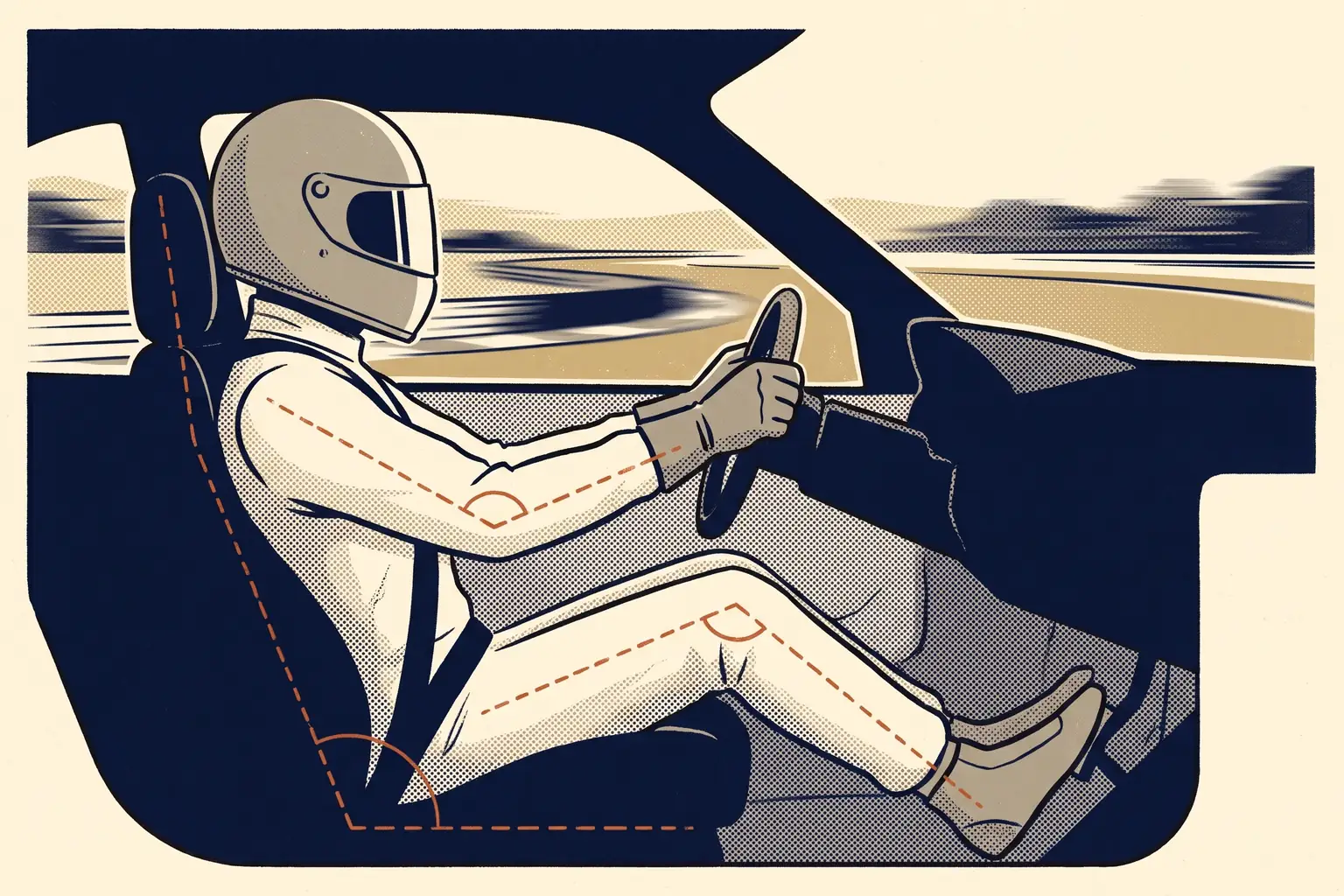
- What is the correct hand position on the steering wheel?
- On the sides of the rim, at 9 and 3 or at 10 and 2, with your elbows slightly bent. Argentine rules require both hands but do not set a clock position. With an airbag in the wheel, 9 and 3 is the better choice, with the thumbs resting on the rim rather than wrapped around it.
- How far from the steering wheel should you sit?
- Close enough to press the clutch or brake to the floor with the knee still slightly bent, and to rest your wrist on top of the wheel without lifting your shoulders off the seat. The driver manual of Argentina's national road safety agency (ANSV) asks for more than 25 cm between your chest and the steering wheel; the New York Governor's Traffic Safety Committee gives the same figure, at least 10 inches.
- How should you hold the steering wheel in the driving test?
- With both hands. The Buenos Aires province driver manual asks for a correct and comfortable seating position in the practical test, both hands on the wheel, no elbow on the window, mirrors adjusted and the seat belt on before starting. It does not require a specific clock position. The only exception it makes is reversing, where one hand on the wheel is accepted.
- Where should the head restraint be?
- According to Argentina's national road safety agency (ANSV), its top edge should sit between the top of your head and eye level, no more than 5 cm from the back of your head. If it sits at neck height, it is set wrong.
- Does the driving position change for drifting or track driving?
- The basics are the same, only stricter: seat a little closer, backrest almost upright, shoulders always against the seat and hands at 9 and 3, because countersteering asks for a lot of fast steering in both directions. With a helmet on, also check that it does not touch the roof.
- Why do Formula 1 drivers sit almost lying down?
- Because the car is designed to sit very low and the reclined position helps lower the centre of gravity; the seat is also moulded to each driver's body. Copying it in a road car does not work: with the backrest too reclined, the seat belt no longer holds you properly.
 By Dmitrii McCarthy