How to Join the Drift Community in Argentina With No Contacts
 By Dmitrii McCarthy
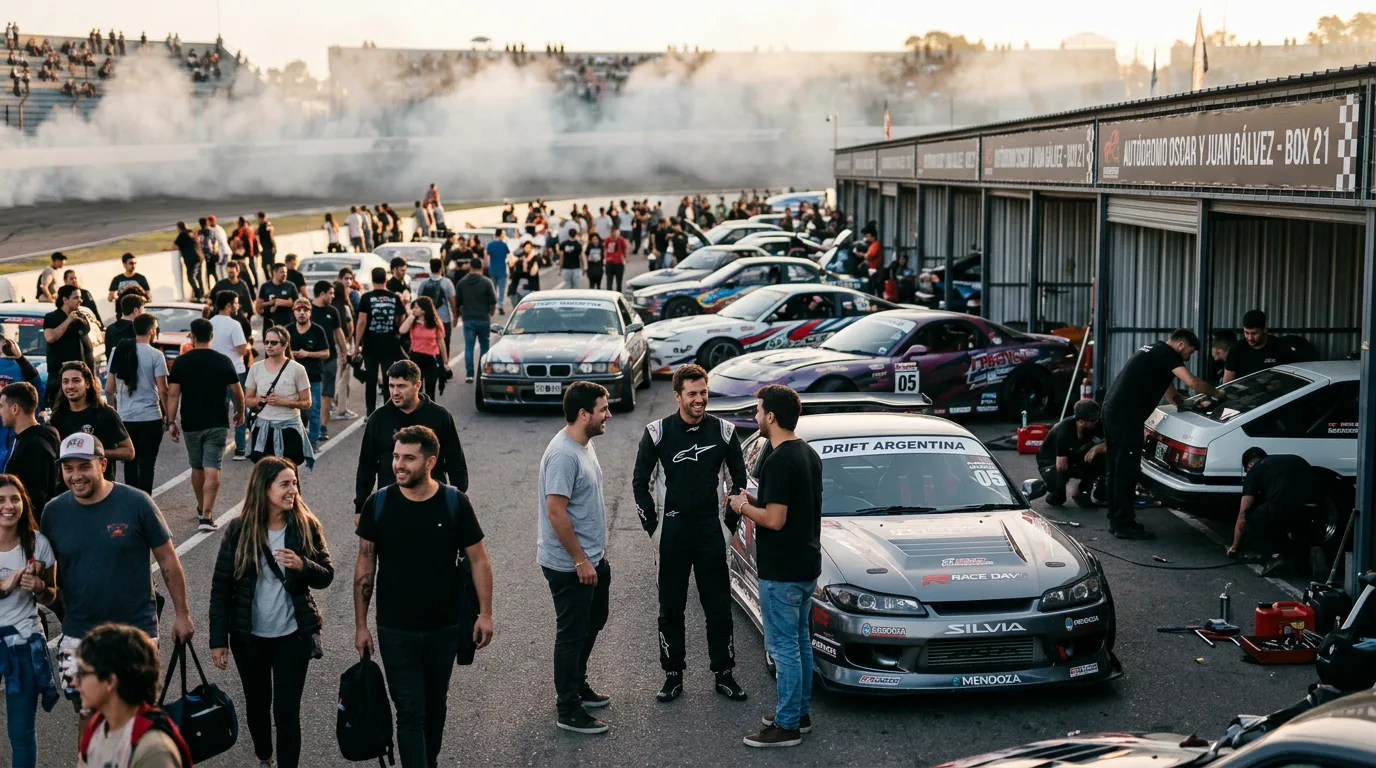
The community is not a closed club, it is a paddock
If you made it here, you probably think Argentine drift is a closed circle you only enter if you know someone. It is the number-one fear of everyone starting out: that you are an outsider, that people will look at you funny, that there is a secret code. The reality is the opposite. The drift community in Argentina is small — a few hundred active people across the whole country — and precisely because of that it is one of the most open in motorsport. Nobody was born knowing. Everyone who competes today started out standing in a paddock knowing no one, exactly like you.
Getting in is not about contacts. It is about showing up in the right places, online and in person, with the right attitude. In this guide we give you the exact map: where the community lives, how to approach it knowing no one, what the unwritten etiquette is, and the fastest path to go from watching videos to being part of the scene. Whether you are in Buenos Aires, Cordoba, Rosario or anywhere else in the country, the path is the same.
Where the community lives: Instagram first
The scene's center of gravity is not a forum or a website — it is Instagram. That is where dates are announced, practice videos are posted, cars and parts are sold, and groups are formed to attend events. Before you set foot on a circuit, your first move is to follow the accounts that actually move the needle. These are the real, verified ones:
- @driftgpargentina — Drift GP Argentina, described as the first Argentine drift championship. They have a public rulebook and post dates and results on their account.
- @agr_driftcompeticion — AGR Drift Competicion, a team and organizer based around Alta Gracia (Cordoba) that has competed in the Argentine championship for years.
- @driftsudamerica — Drift Sudamerica, the regional-level championship that brings together teams from Argentina and neighboring countries at events with exhibition, tandem and food.
- Track Day Argentina (TDA) — the largest track-day organizer in the country (trackdayargentina.com.ar). It is not a drift championship, but it is where you actually practice on track and where you meet half the scene.
One important, honest detail: the exact 2026 championship dates are almost always published only on Instagram, not on Google. Do not trust stray calendars you find around the web — check the dates directly on each series' official account. It is the only source that will not mislead you.

When you follow these accounts, do not just watch. Comment, send a message asking when the next public-facing date is, save the event posts. The algorithm will start showing you the local drivers, the parts shops and the regional groups. Two weeks of following the right accounts and you will have a mental map of who is who.
How to get in knowing no one
Following accounts is the warm-up. The match is played in person. The number-one way to enter the community is to go to a track day or a competition date as a spectator. Watching is usually free or very cheap, and no one will ask you for credentials. It is literally walking up to the paddock.
Once you are in, the rule is simple: talk to people. Drivers between runs are relaxed, having a coffee next to their car, and most of them enjoy explaining what they do. Walk up, introduce yourself as someone who is starting out, and ask genuine questions: how did you start, what car is that, where do you practice. In a single paddock day you will meet drivers, mechanics and enthusiasts, and almost certainly someone will add you to a WhatsApp group where everything is coordinated.
The unwritten etiquette: do not be "that guy"
Every small community has rules nobody writes down but everyone respects. Break them and you earn a bad reputation fast in a world where everyone knows everyone. The basics:
- Do not play the expert on day one. Listen more than you talk. Nothing lands worse than the newcomer with an opinion on everything.
- Respect other people's timing. If a driver is getting ready to head out on track, it is not the moment for your long chat. Read the room.
- Offer help before asking for favors. Hand over a tool, hold a spot, help push a car back to the pit. Reciprocity is the paddock's currency.
- And the most important of all: never, ever drift on the street. Not only is it illegal and dangerous — your car can be seized and you can face criminal charges — it is also the fastest way for the serious community to close its doors on you. Real drifting happens on a circuit or a closed track. Full stop. Whoever is doing street runs is not part of this community; they are exactly what this community is trying to shake off.
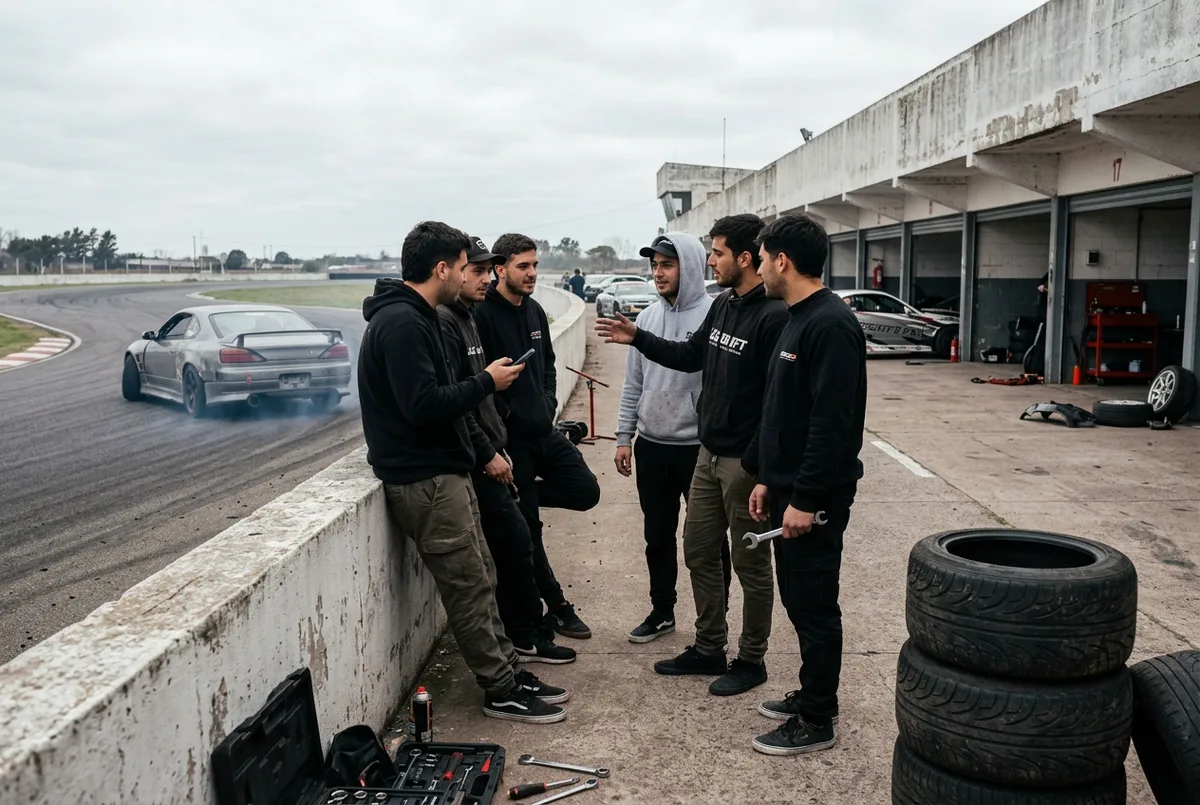
The real progression: class, track day, amateur, pro
Once you are in, it helps to know what the path looks like so you do not get frustrated. The typical progression in Argentina has four clear steps:
- 1. Class with an instructor (day 1). You learn the fundamentals — throttle, counter-steer, initiating and holding the slide — in a prepared car with no risk. This is where you find out if drifting is for you.
- 2. Track day (first months). Free practice on a circuit, at your own pace, with your car or a rented one. This is where you actually become known in the scene, date after date.
- 3. Amateur (from the one-year mark). Once you link corners and handle the car with ease, you start entering amateur categories in the local series. Getting here takes at least a year of consistent practice.
- 4. Pro. The level you see in the videos: extreme angles, tandem, 400 and 500 HP cars. It is the ceiling, and it takes years of track time.
Nobody jumps from the couch to pro level. But the good news is that the first step — going from spectator to participant — is far more accessible than it looks from the outside. If you want to better understand the difference between practicing at a track day and competing, read our guide on drift vs track day.
The honest shortcut: a class puts you inside on day one
This whole guide works if you have the patience to build your place little by little. But there is a shortcut that is not cheating: take a drift class. It is the fastest way to go from watching to being inside, because you start straight on track, with a car, with an instructor, surrounded by people from the scene from minute one. You do not need your own car, contacts or experience.
At our drift school in Buenos Aires, classes start at $300 USD for 30 minutes (Drift Intro), $500 USD for 60 minutes (Drift Experience), or $2,000 for the 5-session Pro Driver Course. All in a prepared BMW E36 328i RWD with a locked differential, on a closed track in the outskirts of Buenos Aires. We coordinate the exact location via WhatsApp.
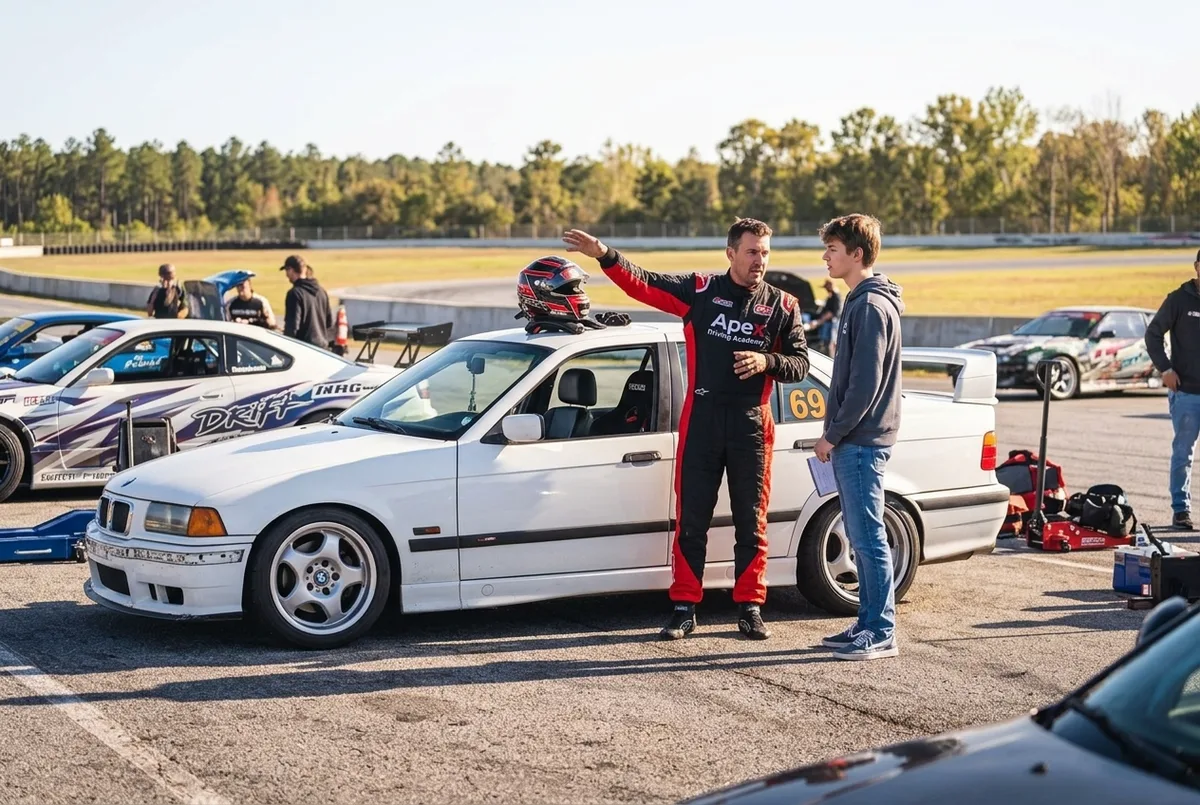
The instructor does not just teach you to drift: he explains how the scene works, who to follow, where the next dates are, and how to take your next steps. You leave your first class not only knowing what it is to carry a car sideways, but with one foot already inside the community. If you want to see the full learning process, read how to learn drift in Buenos Aires or the definitive guide to starting drifting.
The rest of the cluster: where, which circuits and which events
This guide is the community piece of a bigger cluster about the drift scene in Argentina. If you are still missing the full picture, continue here:
- Where to drift in Argentina — the parent guide: circuits, community and how to start across the country.
- Where to drift near Buenos Aires — the real options by proximity to CABA.
- Argentina's circuits for drift — the national catalog circuit by circuit.
- Drift events and championships 2026 — real dates and series to watch or compete.
Frequently asked questions
How do I get into the drift community if I do not know anyone?
By showing up. First online: follow the real organizers on Instagram (@driftgpargentina, @agr_driftcompeticion, @driftsudamerica and Track Day Argentina) and find out the next date. Then in person: go to a track day or competition as a spectator and talk to people in the paddock. No one will ask for credentials. In a day you meet people and almost certainly get added to a WhatsApp group.
Are there WhatsApp or Telegram drift groups in Argentina?
Yes, the fine coordination happens through regional WhatsApp and Telegram groups. They are not openly published — the way in is to meet someone from the scene at an event. That is why going to a track day in person is the step that unlocks everything else.
Do I need my own car to start being part of the community?
No. You can start by going as a spectator (free) and taking classes with the car included. Buying and preparing a drift car costs between $15,000 and $25,000 USD, a decision that only makes sense once you know drifting is your thing. To start, a class from $300 USD with everything included is the smartest path.
How long does it take to go from beginner to competing?
At least a year of consistent practice to reach the amateur categories. Your first controlled slide happens in the first 30 minutes of a class; linking corners with ease takes several hours of track time spread over months. The pro level you see in the videos comes with years.
Where do I take the first class?
At our school in Buenos Aires, on a closed track in the outskirts of Buenos Aires. Classes from $300 USD (30 min) in a prepared RWD BMW E36, with 1-on-1 instruction and no prior experience needed. You coordinate date, time and location via WhatsApp at +54 9 11 6833 3342.
Ready to stop watching and get inside? Book your drift class and start building your place in the community from day one.